Dotted Eighth Delay Studies

Setting up the U2/Hillsong delay in a variety of situations.

The Sessionists

Esther Subra (vocals), Serena Chew (keys), Justin (guitars), Alphonsus (drums and percussion)

Thoughts on G.A.S.

Why you should save up for an expensive guitar.

Setting Up Disaster Area DPC-8EZ and DMC-8D MIDI Controllers

An easy-to-follow video tutorial to get those patches programmed!

An Overview of My YouTube Channel

Feel free to browse some of the playlists on my channel. Hopefully this leads to you liking and subscribing!

Showing posts with label Gear. Show all posts

Friday, February 28, 2020

Can a Strandberg Boden Standard 6 P&W?


The Strandberg Boden is an amazing guitar. I haven't come across anything else quite like it: carefully thought-out ergonomics, very nicely balanced weight and feel, and the sounds to make the guitar sing.

Check out my video review of it!


Thursday, July 4, 2019

Can an Ernie Ball Music Man JP6 Play P&W?


My wife got me an Ernie Ball Music Man JP6 with the DiMarzio Liquifire and Crunchlab pickups, and I'm in love with it! In this video, I answer the question if a guitar that's so geared towards metal can play praise & worship.


Wednesday, March 13, 2019

Going Amp-less: A Step-by-Step Process


If you're looking to have a convincing amp tone through the front-of-house without using a physical amp, a preamp pedal by itself isn't going to be sufficient. In this latest video, I outline the process of going ampless with the Joyo British Sound, augmented by an EP Booster and an EQ section with the Line 6 M5.


Thursday, March 7, 2019

Tone Pursuit: Analog vs. Digital

I did a series of two videos to present the pros and cons of the Line 6 Helix versus an analog pedalboard. I love all gear, and believe that there can be a time and place for their use. I hope these bless you!


Wednesday, March 28, 2018

Project Mothership with Goodwood Audio (Custom Pedalboard Setup)


I did it. I bit the bullet and got myself a custom setup from the wonderful folks at Goodwood Audio. The following videos document the build process, some sound samples from the rig, as well as a full song demonstration of my pedals. I've also added a video on how to program patches on the DPC-8EZ and DMC-8D.

And for those who need pictorial summaries:


I hope these videos help you in your decision-making regarding pedalboard setups!

Saturday, January 13, 2018

Pedaltrain Nano Adventures for Christmas 2017 ("Last One", said No One Ever)


"Last Pedaltrain purchase, I promise."

"Yes, I'll change to the PT Junior, and ditch the PT Nano. I need the larger real estate."

I'm guilty of making empty promises. My wife knows me better. She knew that I wouldn't last half a month without my itchy fingers needing to tweak or change something up. Now that I've recently purchased a Canon 5D Mark II, I need to Purge some gear to fuel the camera Urge. Purge and Urge.

This iteration of the PT Nano sees a squeezing of 8 pedals, with the following signal path:

  1. Hotone Soul Press
  2. Hotone Komp
  3. Xotic SL Drive
  4. ZVEX Double Rock
  5. GFI Clockwork V2
  6. Hotone Tuner
  7. GFI Specular V2
  8. Mooer Micro DI


I built this with the following in mind:

  1. I wanted a variety of drives in case the Double Rock was too limiting in any way. The SL is a bright and punchy pedal, which can shine through certain amps.
  2. I wanted a dedicated DI box on my board with cabinet simulation for direct-to-board cases. For too long have I showed up at a venue only to find a sub-par DI box and no amps. With the Mooer, it's not the top of the line, but it gets the job done and I haven't had anyone come up to me after a show commenting that my "amp tone" was bad.
  3. I wanted to double this as my acoustic rig. I'll obviously be avoiding the SL drive, but the Double Rock has clean boosts in it (identical SHO circuits on both sides), which may be useful to add volume to my passive acoustic pickup. With the acoustic, I'll mostly be using the Specular for those pad-like drones.
  4. I wanted a lightweight solution to pack into a Mono Tick. No matter how hard I try to use a larger rig, I always come back to my Tick. It's the ideal size and weight for frequent travelling and gigging.

Thursday, November 2, 2017

Pedalboard Adventures November 2017: Building with the JPS

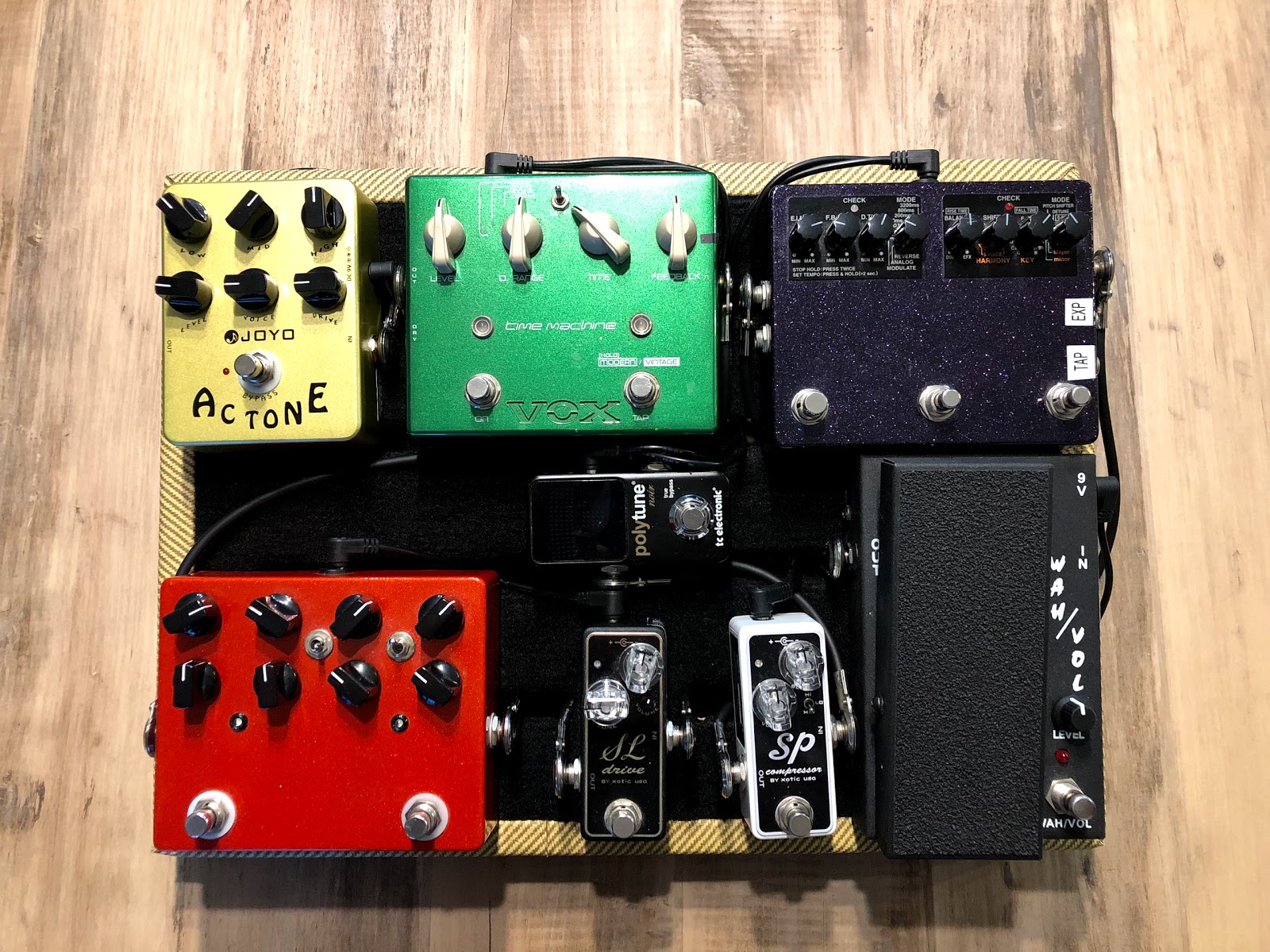
Alas, I have fallen into the trap of building/tearing-down/rebuilding pedalboards. I put together the following builds with the spare "big format" pedals that I had.


This one with an improved outboard application: as my DD-7 rehouse has dual mono outputs, I placed this last in the chain, with one output split to the Joyo AC Tone for direct-to-board, and a dedicated mono output to amp.


The LS-2 was functioning as a tuner split and a buffered input.


Here was a trial of Mark I. The Timmy sounded too shrill into our sanctuary's PA system, regardless of how low I set the treble.


I still wanted more control over the pedals and wanted to avoid the tap dancing. Enter the  build with the Disaster Area DPC-8EZ, which has a buffered input, a tuner mute, and most importantly, preset capability.


Complete with the Palmer DI for direct-to-board applications and a pick tin, I think I'm set! Now to try this rig out at the next rehearsal.


Tuesday, October 17, 2017

New Gear Day: JPS Pedalboard (No Crazy Pedals)

I was inspired by my recent MSM Stringdom Workshop participants who were seeking simplicity of tone for worship to strip down my rig to something much more manageable.


8 pedals. No crazy delay or reverb, just my PS-6, DD-7 and Time Machine for basic delay tones. I can stack the DD-7 into the Time Machine for dual delay sounds, or set them up for two different subdivisions and toggle them when required. 

My BB Preamp and Timmy have made a comeback on this board, and I'm using the Timmy for crunch. I will augment with either the BB Preamp or SL Drive for lead tones, which I've dialed differently. Strangely enough, the SL Drive has more hair than the BB Preamp!

Finally, I have the Joyo AC Tone at the end of my chain as the amp sim, and it is comparable to the Tech 21 Liverpool! Serious!

Sunday, October 15, 2017

New Gear Day: Suhr Modern Satin


This African Mahogany beauty came into the fold as a result of a trade with my Gretch Duo Jet. If I were honest, I wasn't bonding with the Gretsch as much as I thought I would. Yes, it's a "quintessential" worship guitar sound, but it was like playing an electrified acoustic. I had difficulty accessing the 16th fret onwards for solos. And it was just bigger and heavier than my other shred machines.

Yes, I'm aware these guitars are well-suited for the shred genre. And perhaps with its lightweight, fast neck and incredible touch, maybe I could get back to practicing proper lead guitar technique.

Friday, May 19, 2017

Are You Quitting Guitar? (May 2017)


A friend messaged me and asked if I was quitting guitar because of all the gear I was offloading on Carousell. Another joked that I was keeping the guitar pedal economy going by trickling down my effects onto the newer generation of 2nd-hand market buyers. On that latter point, I did realize I'm now part of the 2nd-tier of the gear life cycle; I did build my first analog pedalboard by buying 2nd-hand exclusively, and the sellers offered the same reasons--not having enough time to play with the pedals to justify keeping them, and having to fund other necessities.

Personally, I'm downsizing for both reasons. For a time, I had many TC Electronic, Joyo, and Boss pedals. I had four different amps, two amp heads and two combos. I was going direct to PA most of the time in church, where I primarily play, so why was there a need to keep so much gear? I decided to be resolute and responsible with my time and money. Having recently moved into our own apartment, Christine and I are discovering that everything costs money. If it's not in the house when you need it, you have to go out and buy it. I know, it sounds obvious when it's put that way, but we were living with my parents.

My goal is to sell off all other gear except my Mothership and Interceptor boards, as shown above. I was nearly going to sell off the Mothership, but the level of time, effort and renewed sentimentality (from using it at the recent Night of Worship) has deterred me. You can read up here as to the drama that surrounded the Disaster Area gear, and you can watch this video here as to why I needed the level of control in preset switching.

The Interceptor has all the tones I need and more--the GFI pedals have tremolo, harmony, shimmer, chorus and flange sounds, so that covers my modulation needs. I wasn't sure that I would be able to fit an entirely functional rig onto a Pedaltrain Nano, but I have!


So in short, no I'm not quitting guitar. I'm just streamlining my resources to only have what I need. A big board for the times I need the large degree of control, and a small board for most of my sessions.

Thursday, March 16, 2017

MJT VTS "Andy": My First Heavy Relic Strat

Meet Andy, an MJT VTS strat I recently acquired from a fellow worship guitarist.


For the non-musicians reading this, I can nearly hear you scream, "So ugly!" This was precisely my dear wife's reaction when I revealed that I had bought this. She couldn't believe that there is a market for "relic" guitars, instruments made to look far older than they actually are. She thought someone had thrown this guitar down a flight of stairs. She also said that if I used this on Sunday morning, the congregation will think that I don't take care of my belongings!


When compared to my other strats, yes, it does strike me that Andy looks really beat up. In fact, Kaede (the maple neck '57 reissue to her left) is a 1993 build, making her 24 years old this year. Andy is supposedly only 2 years old!


On closer inspection, yes, Kaede must have found the fountain of youth. So, why did I buy such an "ugly" guitar? (Well, besides the fact that I am a huge Andy Timmons fan!) I'm reminded of a meme that goes like this:


A relic-ed guitar reminds me of the fact that the guitar is meant to be played. It makes me want to practice even harder so that my skill matches the amount of abuse on the guitar. Of course, the argument can be made that you should be practicing (and taking care of your instrument), but a clean, well-maintained guitar can give the impression that you've never touched the guitar. Which of course is closer to the situation in reality; I can barely squeeze in 5 minutes of practice a day!

I feel inspired to practice more, perhaps not as much as I used to (I won't be able to top 8 hour practice regimes anymore), but to be intentional and disciplined in my practice. I could play clean 16th notes at 200bpm before, so I know I have much more latent potential in me. Onward to practice!

For further reading:
http://mjtagedfinishes.com/

Thursday, December 29, 2016

How to Get Great Sounding Volume Swells (Electro-harmonix Freeze)

The Electro-harmonix (EHX) Freeze is one of those pedals that's really quirky. I didn't know how to use it in the context of my music, until I saw one on Jon Carolino's board and wondered how he could achieve epic-sounding volume swells.

Part of the secret, I believe, is to use the Freeze as an infinite sustainer so that the chord to be processed by the delay and reverb effects has much more volume than just a normal swell. I've recorded a video detailing how I've used the Freeze, including its placement above the volume pedal (in which case, you'll also need a small volume pedal, like the AMT Little Loud Mouth).


Check out the Amazon link above to get yourself a Freeze!


Saturday, December 24, 2016

Ministry Musings: Adapting Your Tone for a School Hall Environment


I was asked to serve at this year's youth camp, which led to the building of this Pedaltrain Junior board to ensure maximum compatibility with any sound system I was going to plug into. I gladly took it up considering my dosage of vitamin M (for music) has been quite low for the year. I know, what with my worship leading commitments, I should have a healthy dosage of vitamin M since I serve twice a month at Contemporary Service.

It's different. As a musician, I get to focus on my guitar parts, the tone from the effects, and the expression of emotion as I play. My task as a worship leader forces me to push all that musical awareness to the back. I have to worry about how the songs gel with the rest of the service, liturgically and musically. I have to make sure I'm directing the band to play in a certain way, that my vocals aren't distracting (as I'm not much of a singer), and that the scripture I read and prayers I lead point the congregation in a particular direction.

That aside, this post is primarily about adapting to various sound environments. Specifically, let's address the issue of serving in a school hall.


I served with Jeremy and his worship team for their first morning session, and I was immediately greeted with a technical problem: the sound system made everything sound muffled, especially when amplified through a school hall. A school hall, with tall ceilings, sonorous floors and glass doors, will have some crazy long reverberation that will colour your guitar tone. The goal is to make everything crips, clear, and clean, allowing the hall environment to accentuate your tone, rather than muffle it.


I did a few things on the board to try and be as clear and articulate as possible:

  1. Cut out all short reverb effects, including long background delays. I usually have a mild reverb coupled with a long delay with a low mix to cushion my tone in the background. In our usual worship space, which is a cinema hall, instruments tend to sound too dry (think of a studio environment).
  2. Tweak the EQ on pedals to cut out the low end and boost the mids. I did this on my "pre-drive" pedal, a CMATmods Signa Drive, and the tone controls on the Hotone Komp compressor, which has a sparkle switch and a tone knob.
  3. Use digital delays instead of analog-style delays. I have a DD-7 which has a crispy clean digital mode, a much more desirable sound over the rest of my analog delays on the board (a Strymon Brigadier, and an Earthquaker Devices Dispatch Master). The natural reverb of the hall will colour the repeats of my digital delay anyway.
In the end, I was only using at most 5 of the 15 pedals on my board, but that is precisely the point--I designed the board to have maximum compatibility with any sound situation I was placed in. If I only had 5 pedals, I'd have to make do with the tone that I have, and won't have any leeway to tweak.

Tuesday, December 20, 2016

Recommended Gear for Beginner Electric Guitarists (TC Electronic/December 2016)

This page is written primarily for my guitar students who want to get themselves some gear but have no idea where to start, but if you're here browsing, do feel free to check out the links below!

Some things to let you know before you peruse these links:

  1. I tried to make it as simple as possible for you by compiling all the links together from one shop. I love Amazon and it's the simplest way to shop online.
  2. The total cost of this rig will be under $500, which may sound like a lot of money, but I assure you the tone is 100% more satisfying than getting a multi-effects unit that you may spend hundreds of hours on to get one workable tone out of.
  3. You don't necessarily have to buy everything at once. If cash is an issue, build your rig piece-wise. That's the great thing about analog--your rig is as small or as big as your needs are.


Pedaltrain Nano


OneSpot Power Supply


Hosa Patch Cables


TC Electronic Spark Mini Booster


TC Electronic MojoMojo Overdrive


TC Electronic Dark Matter Distortion


TC Electronic Flashback Mini Delay


TC Electronic Hall of Fame Mini Reverb


TC Electronic Ditto Looper


Some videos to show you what you can do with these:


I hope this helps!

Twitter Delicious Facebook Digg Stumbleupon Favorites More