The Strandberg Boden is an amazing guitar. I haven't come across anything else quite like it: carefully thought-out ergonomics, very nicely balanced weight and feel, and the sounds to make the guitar sing.
I did it. I bit the bullet and got myself a custom setup from the wonderful folks at Goodwood Audio. The following videos document the build process, some sound samples from the rig, as well as a full song demonstration of my pedals. I've also added a video on how to program patches on the DPC-8EZ and DMC-8D.
And for those who need pictorial summaries:
I hope these videos help you in your decision-making regarding pedalboard setups!
The new string feeling is amazing. I took a break from essay writing by trying on a set of D'Addario NYXL strings. I had wanted to try a low tuning to play stuff from A Perfect Circle. As much as they aren't a good influence in terms of lyrical antithesis to my Christian faith, James Iha and Billy Howerdel are geniuses at crafting intricate but simple guitar lines.
My plan to play in Standard C# failed. As it turns out, the string tension when top-wrapping a Les Paul drops significantly, to the point that I didn't need to crank my tuners that much to raise the strings to pitch. At Standard C#, the strings were flappy and had very little tension, feeling like 8's and had a terrible time staying in tune.
I raised the pitch to Standard Eb, and it was a much better experience.
Oh well. Lesson learnt: I’ll try out 13 gauge and drop tune that next time!
This African Mahogany beauty came into the fold as a result of a trade with my Gretch Duo Jet. If I were honest, I wasn't bonding with the Gretsch as much as I thought I would. Yes, it's a "quintessential" worship guitar sound, but it was like playing an electrified acoustic. I had difficulty accessing the 16th fret onwards for solos. And it was just bigger and heavier than my other shred machines.
Yes, I'm aware these guitars are well-suited for the shred genre. And perhaps with its lightweight, fast neck and incredible touch, maybe I could get back to practicing proper lead guitar technique.
I recently got a hold of a Gretsch Duo Jet. It's a completely unique instrument, with certain quirks that takes some time getting used to, and a sound that has twang and growl, a balance between a single coil and a humbucker.
Here's a video I made that shows the unique tones and control scheme for the Duo Jet. I would have spoken and have some dialogue, but there's constant construction happening around my new home!
Meet Andy, an MJT VTS strat I recently acquired from a fellow worship guitarist.
For the non-musicians reading this, I can nearly hear you scream, "So ugly!" This was precisely my dear wife's reaction when I revealed that I had bought this. She couldn't believe that there is a market for "relic" guitars, instruments made to look far older than they actually are. She thought someone had thrown this guitar down a flight of stairs. She also said that if I used this on Sunday morning, the congregation will think that I don't take care of my belongings!
When compared to my other strats, yes, it does strike me that Andy looks really beat up. In fact, Kaede (the maple neck '57 reissue to her left) is a 1993 build, making her 24 years old this year. Andy is supposedly only 2 years old!
On closer inspection, yes, Kaede must have found the fountain of youth. So, why did I buy such an "ugly" guitar? (Well, besides the fact that I am a huge Andy Timmons fan!) I'm reminded of a meme that goes like this:
A relic-ed guitar reminds me of the fact that the guitar is meant to be played. It makes me want to practice even harder so that my skill matches the amount of abuse on the guitar. Of course, the argument can be made that you should be practicing (and taking care of your instrument), but a clean, well-maintained guitar can give the impression that you've never touched the guitar. Which of course is closer to the situation in reality; I can barely squeeze in 5 minutes of practice a day!
I feel inspired to practice more, perhaps not as much as I used to (I won't be able to top 8 hour practice regimes anymore), but to be intentional and disciplined in my practice. I could play clean 16th notes at 200bpm before, so I know I have much more latent potential in me. Onward to practice!
This post begins with a story. I've owned the Strymon "Trinity" (the nickname given to the collection of Mobius, TimeLine and BigSky pedals). While I had some limited control with the DMC-3XL, I was clearly in need of a solution to the problem I had with having so many pedals to switch, in addition to the patches I wanted to control on the Strymon devices. I had my heart set on getting the DPC-8EZ and DMC-8D, their two largest controllers that were designed to perfectly complement one another.
So enter the good people at The G.A.S. Station, a local company I chanced upon while searching on ways to bring in Disaster Area gear. I got in touch with Bertram, the proprietor, and we began the creative process of figuring out my rig needs. I placed an order for three things: the two controllers, and 3 packs of Disaster Plugs, the patch cables needed to wire the DPC-8EZ up. The excitement in me was palpable; I haven't had GAS in a very long time! This was in late November.
Bertram was very kind to keep me up to date with messages regarding payment and shipping. He sent me the shipment tracking number and this transpired:
I had hoped the shipment would arrive in December so I would have had time to put together the rig for Christmas services. But look at the date of the picture above. I took the screen shot in late January. The shipment was in transit from Germany for two whole months. There was no use getting angry over the situation; international shipments go awry all the time, and I was simply the one guy in a thousand cases to lose something.
My heart did sink at the prospect of having wasted a chunk of my paycheck--Disaster Area gear doesn't come cheap! So I talked to Bertram, and every effort was made on his part to contact Disaster Area, USPS, SingPost and even Singapore Customs. By early February, we had established that the shipment was indeed lost, but Disaster Area was very kind to build a replacement set for me. Yes, a replacement! Bertram, of course, never disappointed in his timely messages and open communication.
This time, the shipment came really quick. I got my hands on the pedals that I had been waiting three months for:
I would have thought that I'd need a lot of time to get the complete system up and running, but to my pleasant surprise, Disaster Area gear is so intuitive and easy to set up that I was programming patches in no time!
Of course, not all setups with new gear is without problems and learning curves. Here are some things I wish I could have done better:
I don't have proper wire cutters, so I used a large pair of scissors to cut the Disaster Plug cable. I think this may have contributed to the reason I wasn't getting signal in some of the patch cables I made, and I had to recut some patch cables several times to get proper signal.
I don't have a proper cable tester. My cable testing method was plugging the patch cable from guitar to amp. If the signal was strong and noise-free, I had a good cable. If there was no signal, I had to either tighten the ground plug or recut the cable. I would have saved a lot of time if I had a cable tester.
I don't have right-angled, low profile MIDI cables, so there was some pedal real estate wastage, as you'll see in my final setup below. Anyone know where to get right-angled MIDI cables locally?
Here's a quick video I did to show how to configure and program patches on the controllers, for those of us intending to expand our pedalboard with Disaster Area gear:
Once again, a great shout-out to Bertram from The G.A.S. Station! Give them a follow on Facebook and get some cure for that G.A.S.!
Do power supplies make a difference to your tone? I think so, but not in the sense that it enhances the tone, but it just doesn't get in the way with artifacts and excessive hum.
Well, it's time we all moved on. While I'm performing a factory reset of Chiyoko, I'll spend the next minute reminiscing. Chiyoko (which means offspring of a thousand generations) is a Variax 700 and was the guitar that got me into the fast lane of speed-picking. I learnt my licks and riffs from Dream Theater, Paul Gilbert and Joe Satriani tunes off her.
Chiyoko also saw me through my university days. I would resolve to study harder, but she would beckon me to relax for a couple of minutes. Those minutes turned into hours of practicing my chops, jamming to my entire CD library, and just "messing around" the myriad of settings possible with the alternate tuning capabilities of the Variax.
Gigs were so fun with Chiyoko. I'd chuckle at a befuddled audience as is scrolled through electric, acoustic, resonator, sitar and 12-string patches within the set list (those were tough days of playing for "experimental" bands). I saved time in the studio by eliminating the need to change guitars after a good take.
But those days are behind me, and the listener of today is so exposed to digital music that the guitarist should be as organic and authentic as possible. So long, Chiyoko. You'll go on to be with people who will use you better. It's been real.
I'm an unconventional acoustic guitarist. Rather than going through the traditional route of drilling and installing an acoustic preamp on my "purely acoustic" acoustic, I decided to go with a Seymour Duncan Woody pickup:
Contrary to what your pre-conceived notions of acoustic pickups may tell you, it doesn't sound bad at all going through a PA and a keyboard amp (which I suspect is due to the fact that keyboard amps accept line-level and mic inputs to provide flat-response output). I've used this for acoustic gigs, corporate prayer meetings and church, and you know what? I've learnt that the audience can't tell the difference. Yes, I can't EQ the tone, adjust the volume or correct any phase issues, but the basic tone of an acoustic is there.
And the things I bring for the acoustic gig are:
A Korg Pitchblack tuner
A Visual Sound 1Spot power supply
A guitar lead
Yes, it's a rather strange setup for an acoustic rig, but here were my considerations in making this rig:
I'm a sucker for passive pickups. Every acoustic preamp has the problem of 9V batteries waiting to die on you at the most incredible of times. With a dedicated power supply, my mind is free from that point of worry.
With a tuner pedal, I'm able to mute the output with the click of a switch, instead of having to memorize the volume on the acoustic preamp, turn it down, and then having to turn it up when it's time to play again. And that's assuming the 9V battery hasn't died yet.
You might be aghast at the length of cable that's floating about, but trust me, I'd rather have more cable length to walk around the stage than have too little and be confined to a corner, which is probably next to the drummer (and his cymbals).
Fender guitars used to bear the brunt of my guitar manufacturing
criticisms. For a design which has essentially gone without much
significant revision, I concede that Leo Fender got part of the formula
right. I use the term "part" because the design isn't perfect. There
are obvious flaws with the solid-body electric design: early '50s models
can only make truss rod adjustments by removing the neck first, the
V-shaped neck is awkward to grip initially, the tiny frets meant you
have to be precise and fret lightly, and true single coil pickups have
worse grounding than the cheapest radio you can buy.
When faced with
these problems, guitarists can choose to react in one of two ways.
Firstly, they can avoid the problem altogether. It is certainly a more
natural solution to find guitars which address and correct the flaws. Parker and
Steinberger guitars, for example, have far superior playability,
durability, balance, and features. Adrian Belew of King Crimson made the
switch from Fender (most notably known for his iconic pink strat) to
Parker because they "have none of the inherent problems and make [him] play
better".
On the other hand, guitarists can accept the flaws and work
around them. I have personally gone through this route and can attest:
it's a lot of hard work. To play fast and fluidly on a strat requires
one to be precise and accurate with a light touch in both hands. Your
left hand has to accommodate the neck profile and small frets by bending
in a certain way. Your picking hand has to play around the pickup
spacing and slanted bridge pickup, being careful not to knock into the
volume knob.
To cut a long story short, I think by accepting and accommodating these flaws, I've ended up becoming a better guitar player. I was a very heavy player with a heavy hand who came from a metal background, so when the time came to retire from that particular scene, I needed guitars that were suited for far more mellow music. Acquiring my strat and tele has lightened up my touch tremendously, and that has made me far more dynamically-sensitive.
Perhaps most pertinent to a GAS-prone guitarist is that you'll have to acquire more gear to get a single coil to
really sing. They aren't as beefy as their humbucker counterparts, and they tend to have this shrill treble bite to them which isn't too appealing in a modern musical context. My personal solution was to stack my overdrive pedals with some EQ to roll off that high end, both on the guitar and on the amp side. I think this has had the side effect of making everyone's single coil tone unique, in that people use different configurations of pedals and amps to achieve an entire spectrum of tone, from full and fat to thin and shrill.
My simple exhortation to those dismissive of Fender guitars is to try them out. Take a vintage guitar out for a spin. You just might be very pleasantly surprised.
For further viewing:
Dave Hunter and Carl Verheyen demonstrate telecasters
I speak, of course, about my Yamaha AES820. (What else were you thinking?)
Steve Mazur of Our Lady Peace, one of my favorite Alt Rock acts of all time, uses this exact model, and Frank Gambale based his signature model off this beauty of a guitar. It features two DiMarzio custom pickups, a three-way pickup selector with a 3-position rotary coil split (humbucking/single coil/"high cut" variation which sounds like the pickups are hotter and have a treble boost) for a total of 9 possible pickup tones. It has a flatter neck radius, a slimmer neck profile, and closer fret spacing (because of its shorter scale) which helps me play long, complicated lead lines more smoothly.
This guitar saw me through several stages of my life as as guitarist
Early 2001: The beginning of my shredder wood-shedding days. I was learning tunes from X-Japan, Yngwie Malmsteen and Paul Gilbert on this guitar. I also starting serving in the children's worship ministry around this time (applying the term "making a joyful noise" a little too literally).
2002: By this time I was a regular mainstay for the children's church, and made regular noise with jam mates from all over, in school, and at church. Phrygian, harmonic minor, and pentatonic were my favorite scales, and over-the-top distortion was my favorite tone.
2003: I didn't bring this with me when I first went to Australia, and brought only my acoustic guitar. I think it was beneficial too, as I discovered the acoustic music of John Mayer, Jason Mraz and Jars of Clay, and eventually developed my acoustic style based on them. It was mostly in its case until I returned back for vacation to play at the youth camp and for a Christmas production which incorporated elements of both the heavy and the light, of Dream Theater and John Mayer.
2004-2007: Having been recruited into Hope Sydney Christian Church, I became an electric guitarist and served nearly every week due to a lack of musicians. This was instrumental in building up my skills in band dynamics--we needed to be able to come down on Sunday morning, set up, practice, memorize our arrangements, and pull them off for service 2 hours later.
Yes, this guitar was a big part of my musical life. Do you have pieces of gear that also represent pieces of your history?
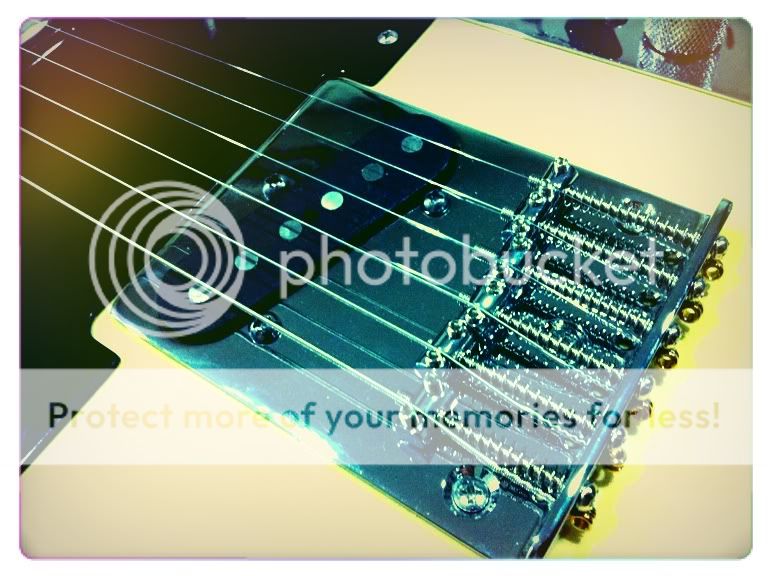
My telecaster came fitted with a "vintage" style 3-piece saddle, which looks like this:
I'll admit, it looks really good and contributes to the allure of a vintage telecaster. It's colloquially known as the ashtray bridge--so called because the full bridge came with an outer case assembly (to keep a streamlined look) that players would take off and use as ashtrays. I wasn't sure I was totally digging the "vintage" tone, but I did miss the ability to intonate individual strings by having individual saddles. Intonating the 3-piece bridge wasn't an easy task, and it often requires a fair bit of time to get it right.
I then swapped it out with this bridge:
I can almost see your horrified expressions and hear the gasps--yes, it's a pretty bare-basic cheap bridge which I got only for the reason of being able to intonate each string. I didn't hear any noticeable change in tone, which could mean one of two things: that there is really no difference between a 3-piece and a 6-piece saddle bridge (please excuse me while I dodge the ashtray covers from the Tele purists), or my ear is really so dull that the change to me really is non-existent.
However, as much as I loved being able to intonate my Tele better, another problem soon cropped up: if you notice the saddle design, it's not exactly the sturdiest thing around. I soon developed the problem of digging so deep into the strings (as a result of my heavy hand) that I'd dislodge the saddle piece. I couldn't play heavily on my Tele, which was a shame considering that a large part of the Tele "twang" resided in the ability to really dig into the guitar.
This awkward setup lasted 6 months before I couldn't stand it any further. I went on to treat myself with something I've always wanted to try:
I went ahead with the Bigsby tremolo. I didn't use a vibramate (which is an additional metal frame to avoid drilling into the guitar) because I wanted maximum vibration between the Bigsby and the body. I also used a Jaguar bridge, which is a trade-off: you can't adjust the string height like on a traditional Tele bridge, but you can adjust intonation. And it's a lot more solid than the cheapo-6-bridge, so I'm back to being able to dig deep into the string without buzzing or breaking something.
Here's the thing about Bigsby which I'd like to make clear for those of you intending to install one: it doesn't change your tone. It doesn't make a Tele sound any less than a Tele, and it won't make that big a difference in "fullness" of tone (as the Bigsby guys try to convince you in their installation videos). What it does affect primarily is playability:
Of course, your Tele can now do slight warbles with the Bigsby vibrato.
The lower string tension allows you to bend easier, so that helps heaps for people with a light left-hand touch like me.
It's a stable system which keeps the instrument better in tune, even if you were to use the vibrato bar liberally (then again, it could also be due to the fact that I have locking tuners, so please leave a comment if I'm wrong about this)
For some strange reason, maybe because of the bridge pickup plate installed with the Bigsby, the bridge pickup responds differently. It breaks up less harshly and isn't as biting, which is a good thing for me since I dial out treble when I play with my Tele anyway. Ok, so there was a slight tone difference.
What bridge do you have on your Tele? Are you a purist who insists that everyone stick with the 3-piece bridge, or are you engineering-inclined like me who prefers intonation and playability over tone?
Dotted eighth, the magical note integral to music of U2 and modern Hillsong. I've come up with several videos to properly explain how to set this up and apply this in a variety of situations: with a proper delay pedal, in the time signature of 6/8, and with a small practice amp that doesn't have displays.
Some background:
Here's a diagram to illustrate what happens when you use the delay:
The
above represents four beats (quarter notes) in a bar of 4/4. The picked
notes (top row as indicated with a ^) are picked on beats 1 & 2 & 3 &... (i.e.
8th notes) while the metronome clicks at 1, 2, 3, 4 (i.e. quarter notes). The
delay notes come in three-quarters of a beat after the note is played (i.e. 3x 16th notes) and appears
right after the next note is played.
Tone Tips: The Dotted Eighth Delay
Tone Tips: Programming the Dotted Eighth in 6/8
Tone Tips: Programming the Dotted Eighth with a Practice Amplifier
Tone Tips: Obtaining the Dotted Eighth on a Manual Pedal
Update: 14 June 2014
Some of you guys have been emailing me asking me why your dotted eighth setup with the "80/20" rule (effect level/feedback level) doesn't sound right. I've investigated several pedals and realized that some pedals function with a mix level knob, not an effect level knob.
What a mix level does is superimpose the wet/dry signal and allocates space between the wet delayed signal versus the dry signal (your playing). So if you have a high mix level, let's say 75%, what you hear is that in the sonic space, 75% is the delay, while 25% is your playing. Suffice to say, this really knocks you off your socks when you try to play this live, as the delay is so much louder than your actual playing.
Your goal in programming a dotted eighth delay is to have the repeats at the same volume as your playing. To achieve this with a mix level control, put the mix at 50% (so the ratio of wet/dry is 50/50). This should make the delay as loud as your playing and not overpower it.
Some of you know me as the advocate for cheaper alternatives to the big guitar brands (Fender, Gibson, etc). I own two Yamaha's that I've designated for outdoor use, or for places where I know that the crowd might be rowdy and there's a possibility of spilt drinks.
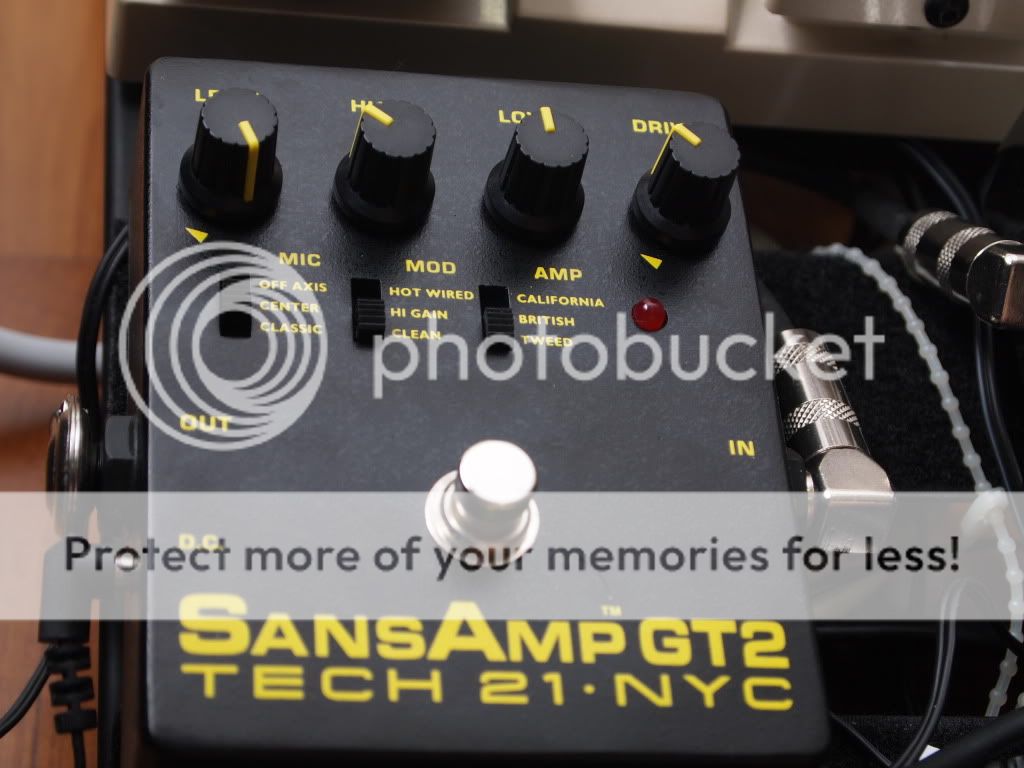
I recently went on a project to test my new SansAmp GT2. I've found a setting that's really good for live use (as heard in the Performing Arts rehearsal rooms, and in the halls of AMKMC), using the GT2 in a clean setting and relying primarily on my overdrives and boosters for dirt. I had wanted to use the same settings for the recording environment, which turned out to be a little more tricky.
I set the GT2 on zero drive and a mild high cut on the British amp on clean with the mic off axis. All overdrive settings were the same throughout. I recorded three snippets with three different guitars, in increasing order of value. Here are the results of the recording project:
First up, the Yamaha RGX-820, the cheapest of the three.
Single note lines towards the end of the video were clear and defined, but chord work in front was muddy and too edgy. I suppose this would work for Japanese pop rock songs (don't you wish they turned the treble/presence down for some of the guitar parts?), or for the situation where I drastically need to cut through a muddy mix.
I then tried the Yamaha AES-820, slightly more expensive than my RGX.
I set this guitar up with the pickups on high-cut mode. Several things were improved over the RGX: there was more definition, and the tone was more full-bodied. With both Yamahas, I had to post-process to get the tone to sit right in the mix, with massive EQ-ing, parallel compression, a tube-warmth plugin, and a stereo enhancer.
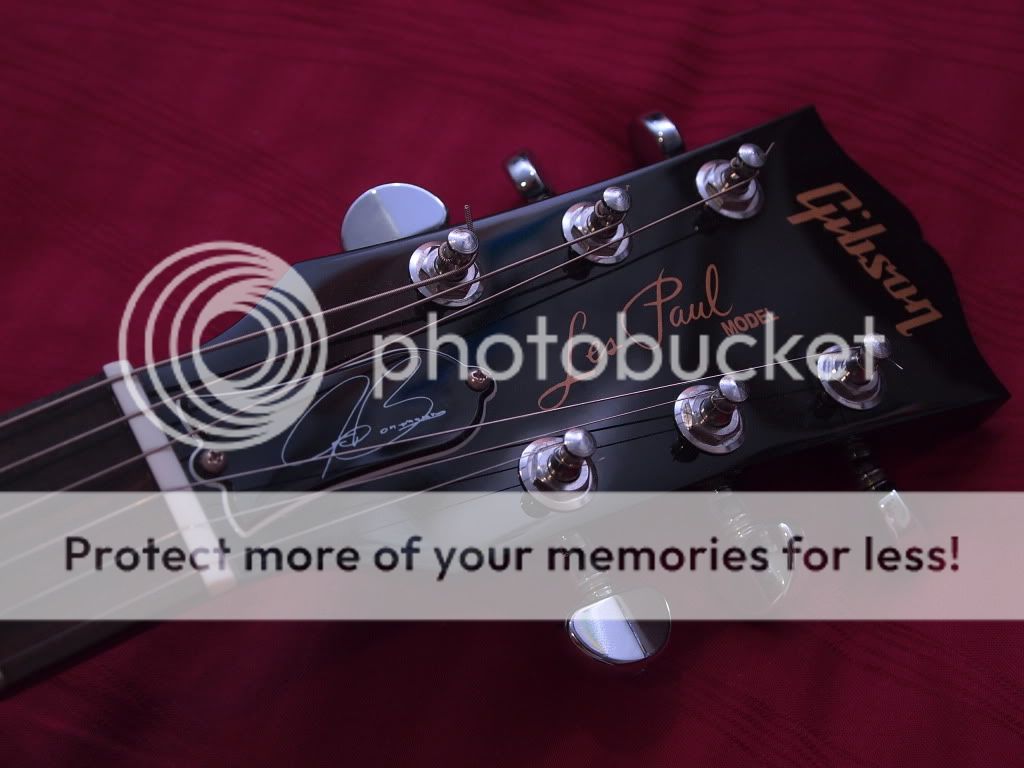
Now, without changing any dials on the GT2, the tone of my Les Paul sounded like this with the bridge pickup volume on 6, tone at 8:
Definition, articulation, warmth, clarity...the Les Paul surpassed the Yamahas by a mile. I didn't have to do any drastic post-processing to get the tone to sound nice, apart from some stereo enhancement. The guitar tone seems to wrap itself around the notes, something I've realized is a quality that is present in my Strat and Tele.
Seriously. If you can save up and get a guitar of good build, it is worth every dollar.
Low
action, a fast neck, high output Burstbucker pickups, trapezoidal
inlays, a curved maple top over a chambered mahogany body...meet Jodie,
my Joe Bonamassa Les Paul Studio. She's my first made-in-America guitar,
and the heaviest of my collection, both in weight and in tone.
Joe
Bonamassa is a recent discovery for me. He belongs to the generation of
American virtuosic guitarists born in the '70s and grew up on English
Blues, hence possessing a unique tone that is a curious concoction of
modern and traditional. While his tone is nearly impossible to replicate
(he makes no apologies for using no less than four different amplifiers
in various combinations), his guitar possesses some features I couldn't
pass up on.
The neck is a cross between a '57 and a '59, not too
chunky yet not too slim, giving a meaty feel when gripped. While it
takes a little getting used to, it quickly becomes a comfortable
platform to pull off long, extended passages. It's awakening the
long-dormant shredder in me from his slumber.
The pickups are a
stock configuration of Burstbucker 2 in the bridge and Burstbucker 3 in
the neck, which on first glance appear to be completely normal and
unassuming. Closer inspection reveals that the pickups are actually
closer to the strings than on a stock Les Paul, giving the guitar a
hotter output with less dynamic sensitivity. While this may cause the
clean tone to suffer (unless '80s-style-overly-compressed clean tones
are your thing), crunch and solo tones have an incredible depth to their
character.
To add to the quirkiness of this guitar, the volume and tone knobs are different for each pickup. This was done because Joe has admitted to forgetting what each of the knobs did, and which pickup they referred to. In this case, the silver-faced knobs are labelled and refer to the bridge pickup, while the traditional translucent knobs refer to the neck pickup.
My only qualm with this guitar so far is its weight. I'm used to carrying around guitars and practicing for hours on end, especially on my Off weekends where I typically clock a good 6 hours on the guitar at least. This guitar has got me putting it down at least once every hour. I'd imagine that if I were to hold it longer, there'll be a groove in my shoulder from the strap pressure!






 The
above represents four beats (quarter notes) in a bar of 4/4. The picked
notes (top row as indicated with a ^) are picked on beats 1 & 2 & 3 &... (i.e.
8th notes) while the metronome clicks at 1, 2, 3, 4 (i.e. quarter notes). The
delay notes come in three-quarters of a beat after the note is played (i.e. 3x 16th notes) and appears
right after the next note is played.
The
above represents four beats (quarter notes) in a bar of 4/4. The picked
notes (top row as indicated with a ^) are picked on beats 1 & 2 & 3 &... (i.e.
8th notes) while the metronome clicks at 1, 2, 3, 4 (i.e. quarter notes). The
delay notes come in three-quarters of a beat after the note is played (i.e. 3x 16th notes) and appears
right after the next note is played.