The Sessionists
Esther Subra (vocals), Serena Chew (keys), Justin (guitars), Alphonsus (drums and percussion)
Setting Up Disaster Area DPC-8EZ and DMC-8D MIDI Controllers
An easy-to-follow video tutorial to get those patches programmed!
An Overview of My YouTube Channel
Feel free to browse some of the playlists on my channel. Hopefully this leads to you liking and subscribing!
Sunday, September 25, 2011
Friday, September 23, 2011
Massive Unboxing!
A clearance sale is bound to strike a good chord in a guitarist. I've always dreamt of owning a THD amplifier for years, having seen small blurbs of it in guitar reviews, and hearing raves amongst my guitarist friends. Reading about the features was enough to convince me that this amp was worth the boutique price tag that it carries.
I finally found a place that sold THD products, and specifically, the combo version of the UniValve! Kudos to Chao for the great tip-off! I made my way from an external course at work, traveling from Science Park to Peninsula Plaza at peak hour, with ERP and parking, just for it. Yes, it's worth that amount of trouble.
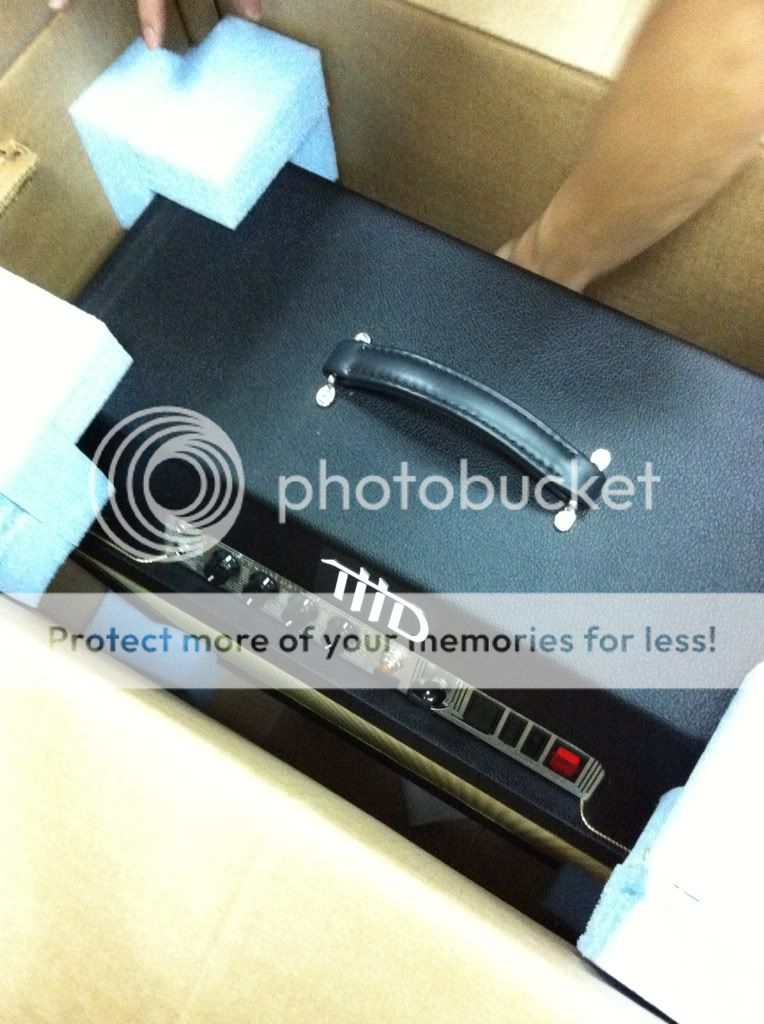
The picture doesn't really show its size. It's a whopping 53lbs and I had to leave the box at the shop!
Unboxing...
The styrofoam in the box provides more of a psychological assurance than actual protection. This baby is built like a tank.
Installing the wheels. Who would have thought it would finally be available on an amp?
And finally, when I lugged it back home and set it up...
This amp delivers serious tone. Everything I threw at it, even my cheapest pedal and guitar, sounded gold. Here's a run-down on what I love about this amp:
The tubes and the Hot Plate
The UniValve is single-ended Class A amp (don't worry, I've provided links to other sites for those of us who don't know the geek lingo), which is my personal preference when it comes to amplification. I think I won't burn the tubes out as quickly as my other friends do, considering my drive section is completely dependent on my pedals and I run the amp pristine clean.
It has two 12AX7's in the preamp and one EL34 in the power amp. Like most tube amps, there are two channels for low or high gain input--which, I recently discovered, simply meant how many tubes were used in the preamp. In the UniValve's case, it's a choice between one or two tubes, and there's a serious jump in the amount of crankable gain between the two channels. The first preamp tube governs the gain and tone of the preamp, while the second preamp tube directly drives the power tube. By varying the gain of these two tubes, you can influence the mix of preamp distortion and power amp distortion, or run a decently clean tone at higher volume by reducing the gain of both.
The power amp tube makes a profound difference on your overall tone, and the EL34 is a favorite of mine. It has a middy character to it, and has a ton of headroom and volume. A friend of mine joked that if you want to hear an EL34 break up, stand really far away.
My favorite setting so far is the volume at half and the Hot Plate at half. If you run your rig like mine, where your pedals are your main source of overdrive, playing your amp at a volume lower than its breaking point will sound over-compressed. However, if you run an attenuator, the more you attenuate the signal, the amp becomes less open and you lose some dynamic depth. It's a delicate balance that I've easily achieved with the UniValve.
The controls
With clean amps, I'm a follower of the fabled Fender Deluxe Reverb mojo settings: 6-6-3 (Bass, Middle, Treble respectively), which provide a woody body and a "blanket" warmth to the guitar tone. Instead of a middle control, the UniValve features an "Attitude" control, which I'll let the company describe: "The Attitude
control determines how the driver stage responds to signal and how it
drives the power tube."
The general idea is that when turned fully counter-clockwise, it's more a Fender-like response, and fully clockwise is more like Marshall. THD says it's not a presence control, but the effect is in the same ballpark, in my opinion. Personally, I like it one-quarter up, to get that Fender character with a bit of Marshall bite.
At the rear, there are speaker output jacks for anything ranging from 2-ohms up to 16-ohms. There is also a fantastic isolated line out jack and control knob. You can actually use the UniValve as a preamp for other amps, or you can run it like stompbox in your signal chain. It also works great for direct recording., although you have to get a cabinet simulator, either from something like the Rock Bug by Carl Martin or the Palmer direct box. Alternatively, for the cheapskates like me, I record direct to my computer and use a free plugin. There is also a switch to toggle between instrument-level and line-level output. Its probably the best line-out feature set you'll see on a tube amp.
A few quirky noteworthy things about this amp to up the collector's value: it's signed by Andy Marshall himself, and every amp has a quote from philosophers, presidents, famous musicians, etc. My amp has George Harrison's quote, "All things must pass".
The cabinet
It's a specially tuned-port bass-reflex cabinet that in their words, "significantly reduce standing-waves inside the cabinet, giving it a very deep, even, tight
and punchy sound." To my ears, this sounds amazingly like a 2x12" cab. However, what really kicked up the cool factor for me is that the cabs are modular, meaning you can swap out the UniValve head from the cab for any of the THD amp heads. If I was crazy enough to get a BiValve or a Flexi head, it's possible to remove the metal grill, stick it into the cab, plug in the speaker cable, and it will fit!
In conclusion
I'm able to pull off tones ranging from Earth Wind and Fire to Dream Theater through this amp. I couldn't ask for more.
In conclusion
I'm able to pull off tones ranging from Earth Wind and Fire to Dream Theater through this amp. I couldn't ask for more.
Further reading:
Monday, September 5, 2011
Pedals: The Essentials
Before rushing out to buy your ten distortion boxes, I hope to provide some insight on things that you'll need (and truthfully need, mind you). A few important points to note:
Power Supply
Noise Gate
Volume Pedal
- Pedals require power, either from batteries or from an AC/DC adapter. Powering pedals is a huge topic in itself, so I'll be brief in this post.
- Every pedal you want to include in the effects chain needs at least two patch cables for input and output.
- Pedals with the option for external control (such as tap tempo, or a latched switch to change channels and presets) will need an extra patch cable. Did I mention you need to get the external controller too?
Power Supply
Batteries have an advantage of having no power cables that could end in a labyrinthine mess, but unless you're willing to dish out the money and time to replacing them, you're better off getting a dedicated power supply. If you're into playing the electric guitar for the long haul, you'll easily acquire more than 10 pedals (and that's a conservative estimate!), so get it right the first time and get a power supply.
Tuner
Tuner
Please make an effort to get a tuner (really, it doesn't matter how much it costs). Regardless of how great your tone is, an out-of-tune guitar is an instant turn-off! If tone loss from using a tuner is an issue for you, put it in the Tuner Out of your volume pedal to remove it from the signal chain, or have a simple true bypass A/B box to split the signal from your effects chain.
Noise Gate
The more pedals you add to the chain, the noisier your signal will get when you stop playing. A gate does what it metaphorically describes; it will close at a certain preset level (threshold), and you can control how fast the gate will close (decay), varying from a fast shut-off to keep things real tight at the expense of sustain, to a slow decay which will let some noise in but keeps the guitar tone natural.
Volume Pedal
Rolling off the volume on your guitar will have the tonal effect of rolling off the high-end and scooping the mids, which could be undesirable as you may want your original signal intact. A volume pedal solves this problem, allowing you to retain your tone at a desired volume level. You can perform the volume swell effect with this by having a long delay set after it.
Bleed and Open-back Combo Amps
I played for RBC's worship conference with Brian Felten (who is absolutely amazing as a teacher and as a musician; I was so honoured to work alongside him!), and the venue we played at was small and enclosed. The placement of the band right next to the audience meant that we were going to have big problems with bleed from the amps.
My amp was facing me, but had its back facing the audience. There were two things I needed to do: find a way to elevate the amp so that the bass frequencies won't travel, and find a baffle to block the sound coming from the open-back combo.
The solution we came up with was this:
You can't really see it, but it's a chair with a backing that fits very nicely over the open-back portion of the amp. It elevated the amp to a height (and an extra blessing was that it was cushioned) where the bass response was still favorable for me as a monitor, but it didn't affect the audience members sitting next to me. The backing was also large enough to prevent excessive bleed from the open-back.
This may seem to be ugly from an audience's point of view, but I am much more in favor of poor "aesthetics" than having the audience bear with a really loud guitar!
Friday, August 26, 2011
BECK (2010)
I'm an avid fan of BECK, mostly because it's a manga that chronicles the struggles, trials and tribulations that a band goes through in their quest to "make it". Which aspiring musician hasn't thought of making it to a festival, to play for a massive crowd, playing your heart and soul out (in the rain, no less, which is a really cool idea but terrible for the instruments).
As much as I like the manga, unfortunately the movie didn't do it justice. The plot development felt squashed and rushed. Like the anime, the movie tried to squeeze too many story arcs together (the band's beginnings, Koyuki's troubles with the Hyodou Band, the band's first few gigs, the band's recording of their demo and subsequent CD distribution, the rivalry between BECK and Belle Ame, and their eventual gig at Greatful Sound). In fact, I felt that it would have been better to split the movie into two parts and develop the individual story arcs more. Maybe then we'd see their relationship with the Indie label, Koyuki's period of tutelage under Saitou, Ray's friendship with Eddie Lee and Dying Breed, just to name a few.
Harold (the manga author) did a great job of depicting how a great band sounds, which, to put it on a canvas, would mean to capture their expressions, their body movements, and their connection to the instruments. This translated well onto film, with the actors knowing how to "rock it out". It certainly resonated with me as a guitarist!
Thursday, July 7, 2011
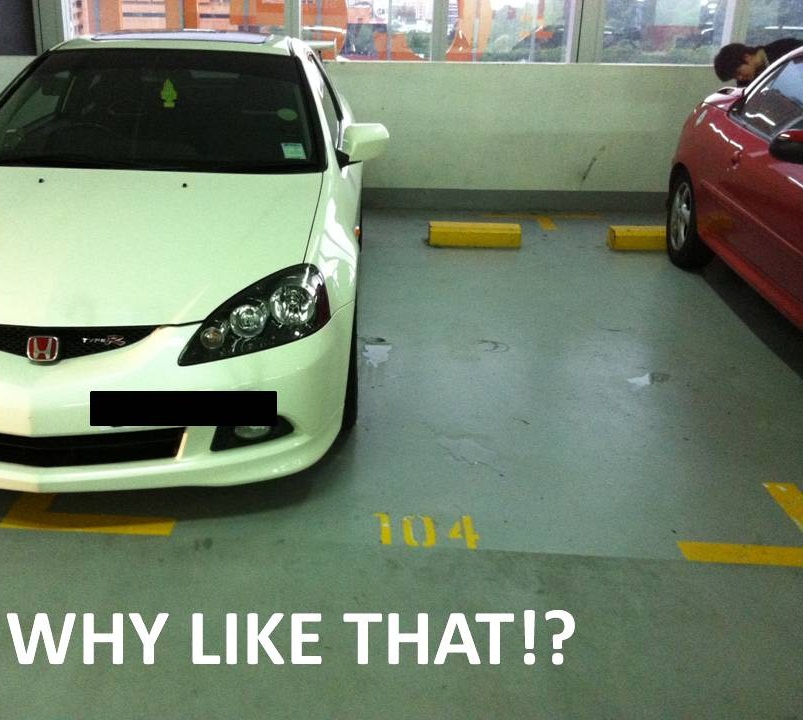
Why Like That!? Episode 2
Multi-storey carparks are difficult to park in; they're tight, they're congested, and they need quick hands to navigate the bends around corners to reach the next level in a bid to find an available lot.
I can understand the level of agitation one may feel at the end of the process, but that's not an excuse to be inconsiderate to other drivers:
I may not know the circumstances behind the driver deciding to make such a hasty parking, which may be legitly urgent, but I think spending 30 seconds more to park properly wouldn't make a difference to the situation, would it?
Monday, July 4, 2011
Why Like That!? Episode 1
A brand new segment of this blog to commemorate the moments that make us drivers go, "Why like that!?"
For this inaugural post, I present to you a parking specimen:
I hope my tone of exasperation is warranted when I say that this guy is too far from the kerb! Private estates have narrow roads to begin with, so it is imperative to park as close to the kerb as possible, not just for other road users to pass, but also for the behemothal rubbish truck to safely pass through the estate when it makes its rounds in the morning. If the truck comes across a bottle neck (caused by, for example, the above), it will not risk scratching the car and give the houses after a miss.
In my book, that's incredibly inconsiderate.
Friday, July 1, 2011
Pedals: An Introduction to Analog
I'll make an honest admission. Even though I've been playing guitar for over 12 years, I only started on analog pedals and amps this year. I've been relying on solid state for all of my tones, from my first 10W practice amp to my present Line 6 PODX3. Of course, it's not like I'm a complete newbie at it; I've gigged with all sorts of analog gear, courtesy of band mates who were kind (and rich) enough to lend me for the night.
Well, why the switch now?
In short, I got bitten by the analog bug. I must have been immune to it all those years when I wasn't earning an income and still a student on a budget. When payday comes, let me assure you, there's a great temptation to rush out and grab as many little metal boxes as your paycheck affords. In a short manner of 3 months, I acquired enough gear to completely fill up a Pedaltrain Pro (see below):
![]() |
| Justin's Pedalboard v2.0, 01Jul11 |
I've had an idea for what kind of tone I was going to commit to for a very long time, so that explains the apparent "shot-gun" style of acquiring my gear. I always liked warm, articulate and fat tones, particularly those in the style of Andy Timmons, Eric Johnson, Dave Weiner, and Ryo Owatari.
Was the switch easy? Not for me. Switching from multi-fx to analog pedals had the same feeling as switching from driving an automatic to a manual. There are so many other things to take note of which multi-fx settles for you, or completely removes for your convenience: the organization of the pedalboard, getting velcro to stick right, patching effects together, setting the volume of individual effects, choosing the right cables for the right pedal...
However, as highly convenient as digital processing offers, having total control over your signal chain is part of the allure of an analog pedalboard. If you're thinking of venturing into the realm of analog pedals, here are some tips I hope you'll find helpful:
- Be specific with your tone. What's the big picture of your tone? Can you describe it in words? By spelling your tone out (it doesn't have to be on paper), you're defining what you really want in your tone and can then make relevant choices. You'll know which pedals you won't need. Trust me, every pedal manufacturer out there will try to convince you that you need their pedal.
- Be realistic with your tone. This pertains to both your concept of tone and your budget for tone. You're not Eric Johnson/Joe Satriani/Steve Vai/(insert guitar hero here). No matter how close your rig is to your favorite guitar hero's, you won't sound like him because you're not him. The faster you assimilate this concept, the less you'll find yourself ogling over his ever-changing overhaul of guitars/pedals/amps. This leaves you more time and money to focus on your tone.
- Be content with your tone. You must eventually learn to draw the line to stop the purchases and concentrate on making your tone sound good. You made a plan, you stuck to it, you got what you wanted. Great! Now it's time to tweak less and practice more. Gear is only a means to an end, which is to make music.
Saturday, April 16, 2011
All Tied Up
When your power cables are kept in this manner...
...you're only inviting disaster the next time you unravel it. The first step to a nicely, naturally-coiled power cable is getting rid of the over-coil.
Next, follow the natural coil of the power cable and use a cable tie to secure it in the middle (I use a velcro cable tie, which can be purchased really cheaply at Daiso), forming a bundle as shown:
There, what a relief it is to see an increased level of neatness!
Wednesday, April 6, 2011
Take Your Pick
Thanks Aunt Nancy for this awesome pack of picks from Hard Rock!
It's good to have picks lying around--in your gig bags, in the accessory pockets of the band duffel bag, in your wallet--you never know when you'll have a guitar dropped in your lap and requested to play a song.
Here's an example of what happened over New Year's Eve dinner, where the performing guitar duo were making their rounds amongst the dinner tables, and Dad just had to mention that I play in a band. Thank goodness one of them was kind enough to lend me his pick:
Dinner at NUSS Suntec, New Year's Eve '10