Dotted Eighth Delay Studies

Setting up the U2/Hillsong delay in a variety of situations.

The Sessionists

Esther Subra (vocals), Serena Chew (keys), Justin (guitars), Alphonsus (drums and percussion)

Thoughts on G.A.S.

Why you should save up for an expensive guitar.

Setting Up Disaster Area DPC-8EZ and DMC-8D MIDI Controllers

An easy-to-follow video tutorial to get those patches programmed!

An Overview of My YouTube Channel

Feel free to browse some of the playlists on my channel. Hopefully this leads to you liking and subscribing!

Thursday, July 31, 2014

A Wake, A Concert, A Dreamer


I conducted a wake service on Sunday evening and helped out at a funeral on the Hari Raya public holiday. It was such a humbling experience and I am truly honored to be granted the opportunity to minister to the bereaved and grieving.

But to be honest, there was much fear and trembling when I was given this responsibility. I had never conducted a wake before (and by that I mean leading the service in worship, preaching, and giving the instructions to pay respects), so of course, some measure of nervousness was to be expected.

Perhaps the moment of greatest anxiety came when I happened upon some Facebook updates of a worship concert that was taking place on Saturday night while I was preparing the sermon, and my friends were serving there. "They have it easy, I wish I was worshipping on the guitar."

God was quick to give His clear instruction, "I've given this to you to do. This is your ministry."

So I prayed continually for strength and courage, and boy, did the Holy Spirit supply in abundance. I felt the familiar sense of empowerment that was not of my own. And as the moments passed, I ended up enjoying the process of preparation. I loved crafting the sermon, digesting the wonderful words of Psalm 23 and listening to the Spirit. I was worshipping with the songs I had chosen for the time of worship. As much as I was to be a minister to people, I was being ministered to.

So the moment came when I had to conduct the service. I still felt nervous, but there was a strength and assurance that was unmistakably from God. Did I do a perfect job? Nope; I slipped up on a few words of my script, my personal ad-lib was far from eloquent, and as always, I sometimes let my mind race too fast for my words to catch up.

But there was a connection I had with God and with the "congregation" of people gathered at the wake. I can't describe it very well, but it felt like my actions and my words were a pair of spectacles to help people see God for who He is, our provider of comfort, strength and hope when it hurts the most. The emotional response as a result of understanding those words choked me to tears; I felt grieved at the loss, but I had a joy that our dear brother in the Lord is secure, and we shall be reunited when Christ comes again.

I may feel inadequate in many things and at many times. But I'm discovering and experiencing first-hand that it is precisely those moments that God chooses to empower me, so that I may not boast. Indeed, in my weakness is His strength complete.

Psalm 23:6
Surely your goodness and love will follow me
          all the days of my life,
and I will dwell in the house of the LORD
          forever.

Saturday, July 26, 2014

OAC? Not Quite.


I found a cafe in HK that used the same stock graphic as my band. That's coincidence for you!

It was a bittersweet moment at this cafe as I started thinking about my musicianship. What do I do with these dreams and ambitions of playing professional music? It's amazing that 15 years have passed and I'm still a hopeful dreamer that someday, somehow, God will permit me the opportunity to use my musical gifts in the marketplace.

Many are quick to jump to the conclusion that I seek fame and fortune. I don't. I really don't! And don't take my word only, look at my life and try to arrive to that conclusion.

"Well, OAC was marketed fiercely."

Of course it had to be! I was managing a brand. As it is with any enterprise, you have to push selling points and can't expect clientele to "magically appear". Since no one was going to do it, I stepped up to the plate. Would anyone else have done it differently? I don't think so.

My observation is that so as long as the band isn't identified as Christian (and by that I mean a band made up of Christians who are active in their faith and unafraid of sharing it), it can pursue any material end by any means and it will still be deemed socially acceptable. "Oh yeah, that's what they have to do to survive. It's a tough market."

But alas, if the band is "Christian", all of a sudden, the same things that help promote the band, the publicity and marketing materials, the campaigns for gigs, any kind of merchandising--the band is seeking "fame and fortune" that is "against their beliefs" and are hence "hypocritical". Where is the hypocrisy? What beliefs am I going against? Does the Christian faith espouse a belief (or a set of beliefs) that deny a band from engaging in contemporary marketing strategies? I'm open to discussion on this, but by and large, I am tasked by the cultural commission to be hardworking, to be resourceful, and to be a responsible head of my household. If that means having to make a living with music, I'd better find a way of doing it responsibly!

Why the double standards? Don't "Christian" musicians need to provide for their families as much as "non-Christians" do? Don't we "Christian" bands need to make a living too? I don't mean to sound like I'm ranting (ah, Christians cannot complain either), but it cheeses me off to no end that there is such a divergent view on Christians attempting to live by their art. We're people too, with real needs and real families to take care of.

Tuesday, March 18, 2014

Gear Shootout: Visual Sound OneSpot versus the Mooer 9V Power Supply

Do power supplies make a difference to your tone? I think so, but not in the sense that it enhances the tone, but it just doesn't get in the way with artifacts and excessive hum.


Which power supply do you prefer?

Sunday, January 19, 2014

New Pedal Day: JHS Superbolt


A prominent SOFTie was selling off an interesting pedal, one which he described was different from the market of tubescreamer clones. As a fan of Supro amps (who isn't after listening to Led Zeppelin and Switchfoot?), I thought it would be a good investment to expand my collection of "amp-in-a-box" style of pedals.


JHS goes for the minimalist approach to pedal graphics--so I have to keep a picture of the manual on my phone just in case I need to tweak and I forget which knob does what. Up until this day, I still get the volume and gain knobs mixed up--the gain knob makes a huge difference in volume, hence my confusion!


The first comment I have about this pedal is that it's really loud! It sounds best through a live amplifier, and instantly turns any amp into a harmonically-complex, dirty-yet-clean, speaker-about-to-explode tone machine with all the goodness tube rectifier sag (No kidding! You have to try it to believe it!). I have played this through a Fender Blues Junior and the Superbolt drove the amp front-end so hard that the input began to distort--in a very musically-pleasing way.

These effects are lost when playing through a digital system (speaker emulation, amp emulation, etc.). When plugged into a speaker sim, the pedal becomes very tame, and at most becomes a clean boost. The tone that you hear from the official gear demos comes from the pedal interacting with a tube amp. So in short, if you're hoping to integrate this into your non-amp rig, you may be in a for a rude shock!

Pros:
  • Turns any amp into a beast of a tone machine.
  • Internal charge pump from 9V to 18V makes this pedal very dynamic and responsive to your picking with lots of headroom.
  • Great first stage overdrive.


Cons:
  • Not great for digital systems (no tube/speaker interaction, where the magic occurs).
  • It's very snarly in the EQ spectrum, so it's tweaked for a certain sound from a certain era. Think '60s rock.
  • Not a shredder's pedal. Don't use this if Malmsteen is a staple part of your repertoire.


My Superbolt demos:
Quick Test (recorded at 2am!)

Full demo of the Superbolt with a Cmatmods Signa Drive and through a SansAmp GT2:


For further viewing:

Official Superbolt videos


Saturday, January 18, 2014

Gear Review: Surprise Sound Lab Rock Block and SE-5 Speaker Emulator

When you hear the terms "1-watt head" attached to an amplifier, the immediate thoughts that come to mind are, "lack of headroom" and "too small-sounding". I was quite pleasantly surprised by two "pedals" offered by Surprise Sound Lab. Why the quotation marks? Well, I can't really classify them as pedals even though they can certainly fit very nicely on a pedalboard. The Rock Block is a true tube-driven, fully analog amp that's a direct competitor to the Zvex Nano Head and can run any cab of your choice, or as a stompbox integrated in your chain of effects. It has a really good clean tone that has surprisingly good headroom. Even when cranked, you can use the good 'ol combination of picking dynamics and pickup volume to clean up nicely.

Here's my video review with the SE-5 speaker emulator.


Understandably, the tone with a speaker simulator will not be the same with a cab played live. Running this into a Vox 2x12" cab really brings out more thumping low-end and definition (which I think will be even better with a 4x12").

As for speaker emulation, I quite like the tweakability offered by the SE-5. Other speaker sims only allow +/-20dB jumps in volume, but the SE-5 offers 8 notches of +4dB increments, allowing you a fair degree of fine-tuning when running this live into a sound console. The tone control is also very useable, and to my ears, going from 0 to 10 corresponds to a decrease in the virtual cab/speaker size. At 0, I think it sounds like the boomiest possible 4x12", and at 10, it reminds me of an 8" Fender Champ, with all the gnarl and snarl associated with those types of speakers.

In this video, I do a shoot-out between the SE-5 and a cheaper Mooer Micro-DI:


Friday, January 17, 2014

Gear Review: The Matthews Effects ICY Buffer


I have a lot of cable running between my guitar to the pedalboard and to the amp, and because my pedals are mostly "true bypass" and I don't use all of them at once, I end up having a giant hi-pass filter in the rig and I lose some high end. When I record, I always have to post-process and add the "sparkle" in by countering the effects of the hi-pass filter.

When I added the Matthews Effects ICY Buffer into my rig, there was a huge difference in the tone--not that it added tone, but it restored the highs in my signal. The result? More sparkle, more definition and clarity, and perhaps most importantly, it made my rig more fun to play. And when you're having fun with your tone, you can concentrate on what's important: the MUSIC.

The effect of long cables and how the buffer restores high end in the rig:

Full review with A/B comparison of clean, dirty, crunch, lead and wah tones:

I recorded all of this through my Mooer Micro-DI with cabinet simulation.

Tuesday, December 10, 2013

Using Instagram as a Gear-a-holic

I was never one to use Instagram until I started following Matthews Effects and Pedal Projects. These guys post regularly on Instagram as one of their main communication streams to update customers (and fans like me) on their recent work, news, developments, and general updates. They are able to get instant notifications on comments and can respond very quickly to specific posts. I think it's a novel way to use social media to keep in touch with your clientele, especially since guitarists are naturally tech-savvy people!

How does it work?
Like other social media sites, the @ and # tags are integral to the use of Instagram. @ tags are for users, and adding them into both your caption and your comment section will push them a notification that they've been tagged (depending on how they've set up their notifications on their smart devices). This is useful for starting conversations or to "forward" a post to a friend who might be interested in it.

For example, I post a picture of my rig just before a gig:


And if Friend A wants to let Friend B in on the photo, he'll post in the comment like:

"@FriendB check out this guy's EHX LPB-1 and Mooer Shimverb!" (Ok, terrible example, but you get the picture)

Hash tags (#) are to include topics in a post, which will make it searchable by other users. Gear communities like @Gearaholic, @Knowyourtone and @Toneheaven encourage users to # them, which effectively shares the post with the wider community. # can also be used in both captions and comments. Here's a list that I currently use, and feel free to use them in your own posts!

#geartalk
#pedalboardfrenzy
#gottone
#gearaholics
#knowyourtone
#worship
#tonefordays
#toneheaven
#gearwire
#thisismypedaltrain
#globalworship

I see Instagram as a great way to:

1. Get pedalboard ideas
I got quite a few build ideas with my Pedaltrain PT-3 from searching up other users. This can go horribly wrong because it may stir up the GAS in you, so ogle with caution! 

2. Meet other guitarists/pedal makers/manufacturers
I love my country, but it's so small that the gear market only carries "mainstream" stuff. With Instagram, I'm able to contact the makers directly, and they're such a joy to talk to! Notably, Rick Matthews from @MatthewsEffects and Asgeir Helgi from @PedalProjects are great people.

3. Posting/hearing gear demos
@GearDemoGram and @PedalProjects are good examples of how the short video function in Instagram can be used to demonstrate gear, using the iPhone audio as a gauge. I know, it's not the best of audio, but it's decent enough to hear 75% of the pedal's "vibe". It's inspiring me to make use of this medium to 

4. Participate in competitions, give-aways, sales
Boutique pedal makers and mainstream manufacturers make use of the holiday season (or when they're in a good mood) to promote their wares. Most of them require the simple procedure of # the relevant topic, like #trexgiveaway, and tagging other users as a shout-out.

So, if you're a guitarist and want to tap into social media, why not give Instagram a spin? Find me @justicepao (it's the nickname I used when I played DOTA back in my uni days)

For further reading:

Thursday, December 5, 2013

The Feel of an Amplifier


I never had a noise issue with the neighbors. When I was starting out, I learnt to shred on a PODxt played through my computer speakers, so the volume was always under control. When I now have the room space and the funds to purchase an actual amp, I seem to have outgrown my shredder phase, and by association, the need for a tube amp.

That being said, I have experienced the joy of a tube amp at its sweet spot. And sometimes, those sweet spots are unavoidably loud. I fondly remember a day in Sydney when I heard an authentic early-era Marshall (with the block logo!) with KT-66 tubes in it. The shop owner grinned at me when I enquired about it and said, "Get ready to hear how heaven sounds like!" It was non-master volume, and when he strummed that E major chord, I almost nearly thought I saw a reinactment of the famous guitar-amp-sends-Michael-Fox-flying scene. Except there was no broken glass. Or people flying.

Amps are made to be loud. The one aspect of playing through an amplifier that digital modeling cannot capture is the feel of the amp, when the speaker and cabinet vibrate, transferring that mechanical energy to the surroundings.

I can think of three contributory factors to the feel of an amp:

1. Cabinet size. Closed-back, open-back, speaker configuration of 1, 2 or 4, cabinet material, whether the cabinet is enclosed with the electronics (like a combo), or separate, height and angle of elevation--these things affect how the cabinet vibrates. In my opinion, amp stands are less helpful than they appear to be. Although they help to point an amp to the guitarist, you will lose a lot of low end because the amp is no longer in contact with the ground. 

2. Power. Many of today's amps are headed towards the micro-amp head design, with smaller wattage ranges from 5W all the way down to 1/4W. Having watched these adverts, I think while the amp makers mean well and present a simple amp design, they over-simplify the role of power in an amp. A small tube amp with a small wattage will never sound big--the speakers aren't being driven hard enough (and probably not big enough either). In my experience, a guitar amp starts to truly sing when the power section runs at 30W. Remember, a tube amp running at 30W is a lot louder than a solid state amp running at 30W.

3. Speaker size. Again, as a result of the micro-amp design, the market is seeing a rise in popularity of 10" and 8" speaker cabs. Now, this is not to say that amps in small speakers are inferior, they're just different--anyone who's played a Supro amp or a Fender Champ will tell you that despite its tiny size, the amp can serve up an incendiary tone. The general rule of thumb is that the smaller the amp and the speakers, the faster the amp breaks up when the volume is turned up. And because the speakers are small, the breakup sounds different to a larger cab being driven hard. Both kinds of tones are palatable and definitely usable; it's just a matter of taste.

For further reading:

Wednesday, December 4, 2013

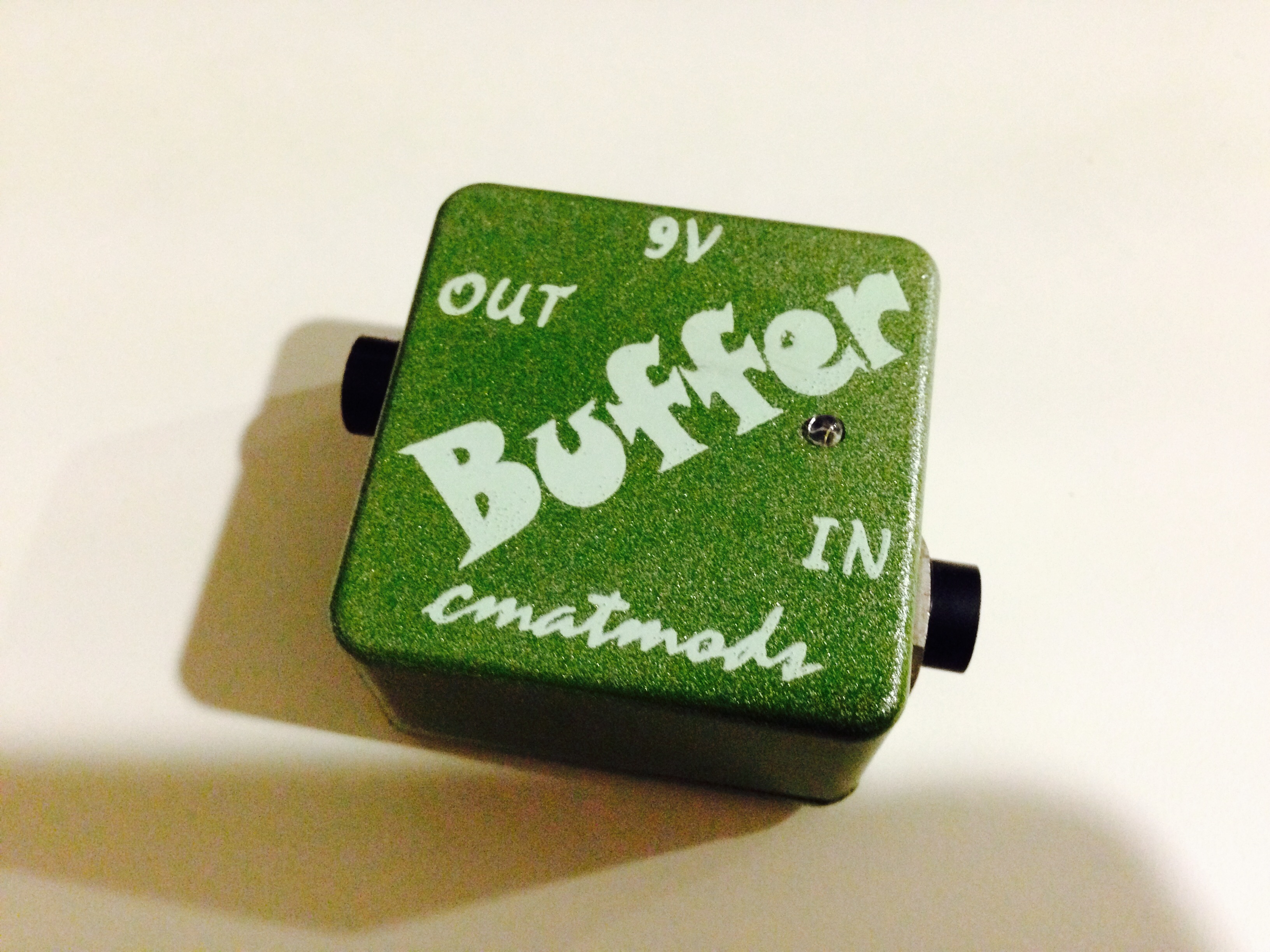
CMAT Mods Buffer Test

I just got a hold of a CMAT Mods Buffer, a tiny little green pedal that I've mounted to the underside of my pedalboard using velcro (it seems to hold well with the patch cable tension).


I conducted a test to check the effect of a buffer. I only changed the placement of the buffer, and the test was as follows:
  1. The pedalboard without the buffer
  2. The buffer placed at the front of the pedalboard
  3. The buffer placed at the end of the pedalboard


I couldn't tell that there was as significant improvement with my tone, possibly because I have Visual Sound and Boss pedals on my board. These pedals are buffered-bypass, which means that when the pedal is disengaged, there is a buffer that will be engaged to lower the impedance of the guitar signal. That being said, there is a difference in tone:

  1. Without the buffer, my tone seems darker and warmer--certainly the kind of tone I'm very used to.
  2. With the buffer in front, my clean tone has a brighter sparkle to it. The overdriven tones have a tad more brightness to it, which is usable.
  3. With the buffer at the back, the clean tone is slightly more bright, but still has some measure of warmth. The overdriven tones also have a bit more sustain (something which the previous owner told me would happen if I placed the buffer at the end of the chain).
So, with the three possible configurations, I decided on putting the buffer at the back. I like warm, clean tones that aren't too overly bright, and I like the effect of the buffer increasing the sustain of the overdriven tones.


For further reading:
CMAT Mods Buffer Product Page
Boss article on buffered-bypass

Thursday, November 28, 2013

Farewell, Fair Well


Well, it's time we all moved on. While I'm performing a factory reset of Chiyoko, I'll spend the next minute reminiscing. Chiyoko (which means offspring of a thousand generations) is a Variax 700 and was the guitar that got me into the fast lane of speed-picking. I learnt my licks and riffs from Dream Theater, Paul Gilbert and Joe Satriani tunes off her.

Chiyoko also saw me through my university days. I would resolve to study harder, but she would beckon me to relax for a couple of minutes. Those minutes turned into hours of practicing my chops, jamming to my entire CD library, and just "messing around" the myriad of settings possible with the alternate tuning capabilities of the Variax.

Gigs were so fun with Chiyoko. I'd chuckle at a befuddled audience as is scrolled through electric, acoustic, resonator, sitar and 12-string patches within the set list (those were tough days of playing for "experimental" bands). I saved time in the studio by eliminating the need to change guitars after a good take.

But those days are behind me, and the listener of today is so exposed to digital music that the guitarist should be as organic and authentic as possible. So long, Chiyoko. You'll go on to be with people who will use you better. It's been real.

Twitter Delicious Facebook Digg Stumbleupon Favorites More