Dotted Eighth Delay Studies

Setting up the U2/Hillsong delay in a variety of situations.

The Sessionists

Esther Subra (vocals), Serena Chew (keys), Justin (guitars), Alphonsus (drums and percussion)

Thoughts on G.A.S.

Why you should save up for an expensive guitar.

Setting Up Disaster Area DPC-8EZ and DMC-8D MIDI Controllers

An easy-to-follow video tutorial to get those patches programmed!

An Overview of My YouTube Channel

Feel free to browse some of the playlists on my channel. Hopefully this leads to you liking and subscribing!

Wednesday, March 28, 2018

Project Mothership with Goodwood Audio (Custom Pedalboard Setup)


I did it. I bit the bullet and got myself a custom setup from the wonderful folks at Goodwood Audio. The following videos document the build process, some sound samples from the rig, as well as a full song demonstration of my pedals. I've also added a video on how to program patches on the DPC-8EZ and DMC-8D.

And for those who need pictorial summaries:


I hope these videos help you in your decision-making regarding pedalboard setups!

Monday, January 29, 2018

An Olympus E-PL1 in 2018?

I recently ran into a photographer whose work I respect at a party. I'd have expected him to bring his crazy rig along, but he arrived with a Sony P&S camera, citing weight and usability for his girlfriend as factors for avoiding bringing a Sony A7RII.

I have a beat-up Olympus E-PL1 that I primarily shoot with a Panasonic Lumix 14mm f2.5. Playing with P mode, I tried to see how low I can go with ISO. The following shots were progressively stepped down from 800 to 200, and finally to 100:


Not bad at ISO100! It definitely looks like daylight is the best time to use this lens and body combo. I have found that anything above ISO800 on the E-PL1 makes things too grainy.

One of the major reasons why I got the E-PL1 in the first place was to use its Art filters. This is the dioarama effect, and it's pretty cool with the wide angle possible with the 14mm!


Again, this was mostly possible with daylight. I suspect it will be a much different story in low light. Will try it out more!

Saturday, January 13, 2018

Pedaltrain Nano Adventures for Christmas 2017 ("Last One", said No One Ever)


"Last Pedaltrain purchase, I promise."

"Yes, I'll change to the PT Junior, and ditch the PT Nano. I need the larger real estate."

I'm guilty of making empty promises. My wife knows me better. She knew that I wouldn't last half a month without my itchy fingers needing to tweak or change something up. Now that I've recently purchased a Canon 5D Mark II, I need to Purge some gear to fuel the camera Urge. Purge and Urge.

This iteration of the PT Nano sees a squeezing of 8 pedals, with the following signal path:

  1. Hotone Soul Press
  2. Hotone Komp
  3. Xotic SL Drive
  4. ZVEX Double Rock
  5. GFI Clockwork V2
  6. Hotone Tuner
  7. GFI Specular V2
  8. Mooer Micro DI


I built this with the following in mind:

  1. I wanted a variety of drives in case the Double Rock was too limiting in any way. The SL is a bright and punchy pedal, which can shine through certain amps.
  2. I wanted a dedicated DI box on my board with cabinet simulation for direct-to-board cases. For too long have I showed up at a venue only to find a sub-par DI box and no amps. With the Mooer, it's not the top of the line, but it gets the job done and I haven't had anyone come up to me after a show commenting that my "amp tone" was bad.
  3. I wanted to double this as my acoustic rig. I'll obviously be avoiding the SL drive, but the Double Rock has clean boosts in it (identical SHO circuits on both sides), which may be useful to add volume to my passive acoustic pickup. With the acoustic, I'll mostly be using the Specular for those pad-like drones.
  4. I wanted a lightweight solution to pack into a Mono Tick. No matter how hard I try to use a larger rig, I always come back to my Tick. It's the ideal size and weight for frequent travelling and gigging.

Friday, December 8, 2017

Bring Me to Life: Trying NYXL on a Les Paul


The new string feeling is amazing. I took a break from essay writing by trying on a set of D'Addario NYXL strings. I had wanted to try a low tuning to play stuff from A Perfect Circle. As much as they aren't a good influence in terms of lyrical antithesis to my Christian faith, James Iha and Billy Howerdel are geniuses at crafting intricate but simple guitar lines.


My plan to play in Standard C# failed. As it turns out, the string tension when top-wrapping a Les Paul drops significantly, to the point that I didn't need to crank my tuners that much to raise the strings to pitch. At Standard C#, the strings were flappy and had very little tension, feeling like 8's and had a terrible time staying in tune.

I raised the pitch to Standard Eb, and it was a much better experience.


Oh well. Lesson learnt: I’ll try out 13 gauge and drop tune that next time!

Monster Curry at Serangoon Nex


Monster Curry hasn't changed in price, but it has changed its practice of upfront payment. You no longer have to pay first!

We tried something different this time: their honey toast, which we think is a just-pass. According to wife, she says it passes the test to satisfy a sweet craving but it's not something to shout about.

In other news, we discovered that NEX has a Lego Store!


Thursday, November 2, 2017

Pedalboard Adventures November 2017: Building with the JPS

Alas, I have fallen into the trap of building/tearing-down/rebuilding pedalboards. I put together the following builds with the spare "big format" pedals that I had.


This one with an improved outboard application: as my DD-7 rehouse has dual mono outputs, I placed this last in the chain, with one output split to the Joyo AC Tone for direct-to-board, and a dedicated mono output to amp.


The LS-2 was functioning as a tuner split and a buffered input.


Here was a trial of Mark I. The Timmy sounded too shrill into our sanctuary's PA system, regardless of how low I set the treble.


I still wanted more control over the pedals and wanted to avoid the tap dancing. Enter the  build with the Disaster Area DPC-8EZ, which has a buffered input, a tuner mute, and most importantly, preset capability.


Complete with the Palmer DI for direct-to-board applications and a pick tin, I think I'm set! Now to try this rig out at the next rehearsal.


Tuesday, October 17, 2017

New Gear Day: JPS Pedalboard (No Crazy Pedals)

I was inspired by my recent MSM Stringdom Workshop participants who were seeking simplicity of tone for worship to strip down my rig to something much more manageable.


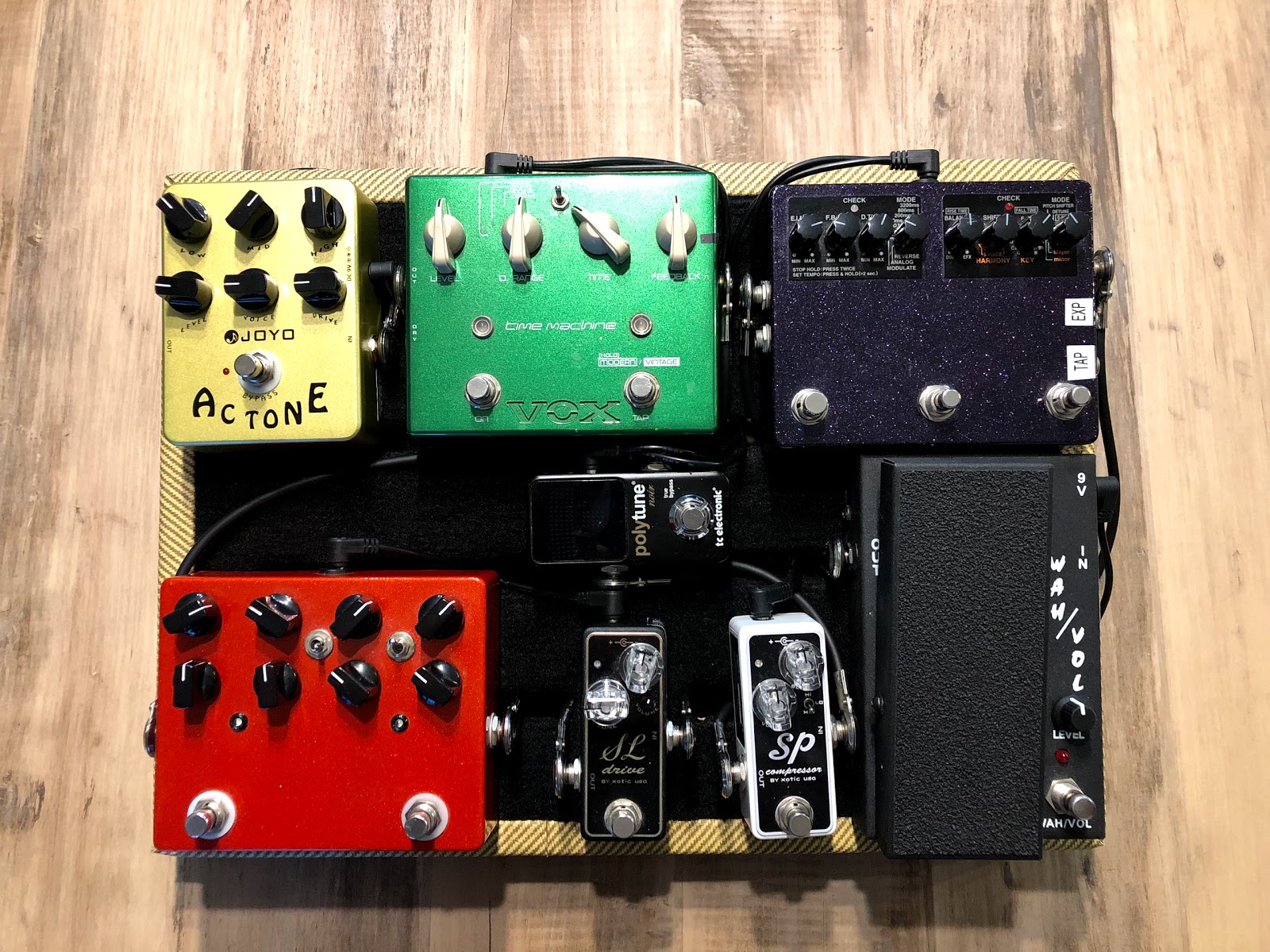
8 pedals. No crazy delay or reverb, just my PS-6, DD-7 and Time Machine for basic delay tones. I can stack the DD-7 into the Time Machine for dual delay sounds, or set them up for two different subdivisions and toggle them when required. 

My BB Preamp and Timmy have made a comeback on this board, and I'm using the Timmy for crunch. I will augment with either the BB Preamp or SL Drive for lead tones, which I've dialed differently. Strangely enough, the SL Drive has more hair than the BB Preamp!

Finally, I have the Joyo AC Tone at the end of my chain as the amp sim, and it is comparable to the Tech 21 Liverpool! Serious!

Sunday, October 15, 2017

New Gear Day: Suhr Modern Satin


This African Mahogany beauty came into the fold as a result of a trade with my Gretch Duo Jet. If I were honest, I wasn't bonding with the Gretsch as much as I thought I would. Yes, it's a "quintessential" worship guitar sound, but it was like playing an electrified acoustic. I had difficulty accessing the 16th fret onwards for solos. And it was just bigger and heavier than my other shred machines.

Yes, I'm aware these guitars are well-suited for the shred genre. And perhaps with its lightweight, fast neck and incredible touch, maybe I could get back to practicing proper lead guitar technique.

Friday, August 25, 2017

Renewed Reflections on Worship Songs

Allow me to preface this reflection with a confession. I have considered myself an "armchair theologian", and I shall provide a working definition from one who has articulated it before:

"An armchair theologian is also an outsider to “the game”. He looks into the academic community of theologians with a keen interest in the topics being discussed. He knows schools of thought, scholars/preachers/pastors associated with them and so forth. He listens to and reads them whenever he can. He develops opinions of his own about the different subjects. Perhaps he understands he’s an outsider and perhaps he doesn’t. Perhaps he presents himself as a “player” and perhaps he doesn’t."

Why do I bring this up? While an "outsider to the game" of academia (hopefully not for too long), I enjoy the academic rigor of thinking through issues that arise from evaluating lyrics and music in worship songs. I can get quite passionate about the discussion--and sometimes, this passion can be misconstrued as callous candor. I am among people in school who have the same disposition--we chat, we argue, we gesticulate, we get quite animated--but we discuss all in the name of wanting to learn more about the differing positions that each of us holds regarding the topic at hand. In other words, we seek dialogue and mutual discourse.

I have, at times, got carried away with conversations with other people who may not have similar dispositions. Most recently, our church worship ministry underwent a revision to our new song selection process. There were several new songs up for consideration, and part of the process required us to comment on theological content in their lyrics (amongst other things).

I confess I got fired up. Here was a chance to engage in meaningful dialogue! But alas, I forget that I am part of the bigger body of Christ, called to a community that has a variety of people, people who may not find rigorous dialogue meaningful, edifying or encouraging. I might have said some things to provoke thinking, but I'm afraid they might have been provoking instead.

To cut a long story short, my "issues" with some of the new songs were of theology and grammar. I had thought that songs with "bad" theology and grammar must not be used for corporate worship (we are what we sing, I always say). However, an evaluation of whether or not theology and grammar are "bad" is subjective (yet another provocative statement), as my interpretation of songs are according to a framework that I have developed over the years. 

I must recognize that evaluative frameworks are not universal--you have yours, and I have mine. My sin is that of trying to impose mine on yours, and it is not my place to persuade you within the space of a single conversation. By way of self-reflection, I have been asking myself the following questions:

Is the theological content truly "bad", or more aptly "incomplete"?

The songs of my beginnings as a Christian were from the late 90's, with Hillsong and Planetshakers at the forefront of what I thought were normative worship expressions. I could articulate the love, compassion, and mercy of God. With the help of these songs, these concepts transcended from being mere words to an enlivening of my spirit, awakening my senses to the reality that God is love.

The medium of music is certainly the aptest to communicate that God is love. It is a cultural norm for us to hear the ideas of love being communicated through the love song (duh, right?), whether in an upbeat, celebratory tone, or an emotive ballad. In our modern context, it would be rather strange and out of place if we used the love song for instruction. We recognize this when we hear songs that could very well be sermons in musical form.

I think that my present preference for sermons-in-songs (or songs that have more instructional material) colors my view on songs of the heart. Does every song need to be a sermon? Does every song need to teach every aspect of God (or by extension, within the "four songs of the setlist")? Many worship leaders are divided over the answers to these questions, but for the sake of my congregation and my local context, I must admit that the answer should be "no".

If I consider a holistic view of the church, perhaps there are other opportunities to engage the congregation with the other aspects of God. Certainly, within the time allotted in service, each item in the order of service (welcome, prayer, offertory, sermon, benediction) contributes to an engagement of the whole community with God. This does not take into account discipleship classes, small group meetings, prayer meetings, various fellowships; indeed, we have such a wide variety of activities to engage the congregation, so why should we load such a heavy burden onto the song?

Hence, theology expressed in a song isn't necessarily "bad", it is incomplete if read in isolation. We should be asking ourselves how the songs being sung in service fit into the wider context of the church, and if found to be truly deficient, we can seek further improvements from there.

Is the grammar truly "bad", or simply "poetically fluid"?

Grammar is dear to my heart. I'm writing this on the Grammarly web app to double-check my grammar. However, I forget that with music and poetry, there is some measure of fluidity with grammar rules. The rules of Hebrew grammar don't apply very well in Proverbs and Psalms because the authors (songwriters and poets, evidently) bend the rules for word-play, analogies, chiastic structures, and emphases. If I spare the Hebrew scriptures such scrutiny and criticism, perhaps I am too critical of English writers.

On a separate note on Hebrew, let me give a recent example that was very humbling for me. I was very insistent that Chris Tomlin was being a poor grammarian when he wrote the lyric, "the God of angel armies". My auto-correct instinct kicked in and insisted that the line should be "the God of the armies of angels". I thought about it a bit more and realized that Tomlin was referencing the phrase, "The LORD of Hosts", more commonly known to us as "Jehovah Sabaoth":

יְהוָ֥ה צְבָאֽוֹת
(YHWH Z'vaot)

Hebrew is a wonderfully compact language. Z'vaot is difficult to express in English, and Tomlin is actually closer to its meaning than the more archaic term, "hosts". I seek forgiveness from those who were at the receiving end of my "grammar tirade" against this song.

In conclusion, please forgive my callous candor. Songs are not sung in isolation from the rest of the service, so I must recognize the other avenues in the church to teach a complete theology of God. Being rigid with grammar rules takes away some measure of beauty in lyrical prose, so I must recognize the time and place for good grammar.

Soli Deo Gloria.

Wednesday, August 2, 2017

MSM Short Course - Bass-ics (Foundations of Bass Guitar in a Worship Team)

I'll be conducting a short 8-session course at the Methodist School of Music, entitled "MSM Bass-ics: Foundations of Bass Guitar in a Worship Team". Registration details are in the Google form below!

https://goo.gl/forms/r6eOUFFLYNqU9Eaj1


See you soon!

Twitter Delicious Facebook Digg Stumbleupon Favorites More