Dotted Eighth Delay Studies

Setting up the U2/Hillsong delay in a variety of situations.

The Sessionists

Esther Subra (vocals), Serena Chew (keys), Justin (guitars), Alphonsus (drums and percussion)

Thoughts on G.A.S.

Why you should save up for an expensive guitar.

Setting Up Disaster Area DPC-8EZ and DMC-8D MIDI Controllers

An easy-to-follow video tutorial to get those patches programmed!

An Overview of My YouTube Channel

Feel free to browse some of the playlists on my channel. Hopefully this leads to you liking and subscribing!

Wednesday, January 16, 2013

How Would You Respond?


I chanced upon this video when browsing a fellow YouTuber's guitar lesson channel. Don't let the Grammar Nazi in you dismiss the video just because of its title--sit down and listen to it. Listen to the anger in the mother's voice. Observe how the guitarist (the subject of the verbal assault) doesn't speak a word against his mother. If you can, put yourself in the guitarist's shoes.

It is unfortunate when one doesn't have the love and support from loved ones. I've been there before, and perhaps even now, I face parental/societal disapproval of what I'm doing with my life, particularly because I devote so much time to music, the guitar, and my ministry. Music is important to me. At one point in my life, I was dreaming of world tours with the band, playing 250 nights a year, playing for sold-out concerts at iconic venues (I have dreams of playing at places like the Royal Albert Hall, Budokan, and our very own Indoor Stadium), and living for the thrill of performing.

Alas, the sad fact of life is that not every boy who dreams of becoming an astronaut becomes one. I have resigned to the fact that I will probably never play in a band that will do world tours, or cut chart-topping CD's, or get to do guitar clinics to inspire young guitarists to play with all their heart and soul. That being said, I have hope: I'd like to think that the musicians I jam with are world class!

I commend the guitarist for not retaliating against his mother. Whether or not he was inwardly spiteful is unbeknownst to us, but I think it was a good move not to speak up. It may appear to be "cowardly", but I'm very sure that silence in this case is the best way to keep things cool and under control. Hear the conviction in the mother's voice. There's no way she will be persuaded by a verbal exchange. She won't understand the value of music in the confines of her son's room. And you know what? I also think that this mother will not understand even if she saw her son performing on stage, where I believe he will be visibly passionate.

I'm in no position to speak about parenting, but I think it's not very helpful to attack your child's dreams and aspirations. I can testify that it really hurts. It shakes a person to the core. It shuts him out even more--he'll want to prove you wrong. He'll want to do it because you said he can't (if he follows his rebelliousness to the end).

How would you respond? How would you speak as a child to your unloving parent, or as a parent to your child with a supposed "useless" dream?

Thursday, November 15, 2012

Bump!

In Col 2:7, Paul exhorts the Colossians to be “overflowing with thankfulness”, which to my mind evokes the image of carrying a full cup of water and walking about. If someone were to bump into me, I would be spilling over the water from the cup. I believe this was the imagery that Paul was using, that when a Christian is bumped into, thankfulness is what overflows. Jesus taught in Luke 6:45:

“The good person out of the good treasure of his heart produces good, and the evil person out of his evil treasure produces evil, for out of the abundance of the heart his mouth speaks.

What comes out of you when you get bumped into? Is it marked with anger, jealousy, bitterness and strife? Or can you cast that aside and labor to instead be reminded of God’s goodness, His love that has saved you? Thankfulness is not an automatic or reflex response. It is much easier to be spiteful, hateful and thankless, like a stone rolling downhill. But thankfulness needs effort and labor, like rolling a stone uphill. Let us be continually reminded (and to remind our young ones also) of the love God has for us, for in His love, our hearts cannot but respond with gratitude.

Thursday, November 1, 2012

The Inner Geek (and the New Office)

The move from Midview to church:


Some shots of the sanctuary (the pews haven't been brought in yet):


And once we settled into office:


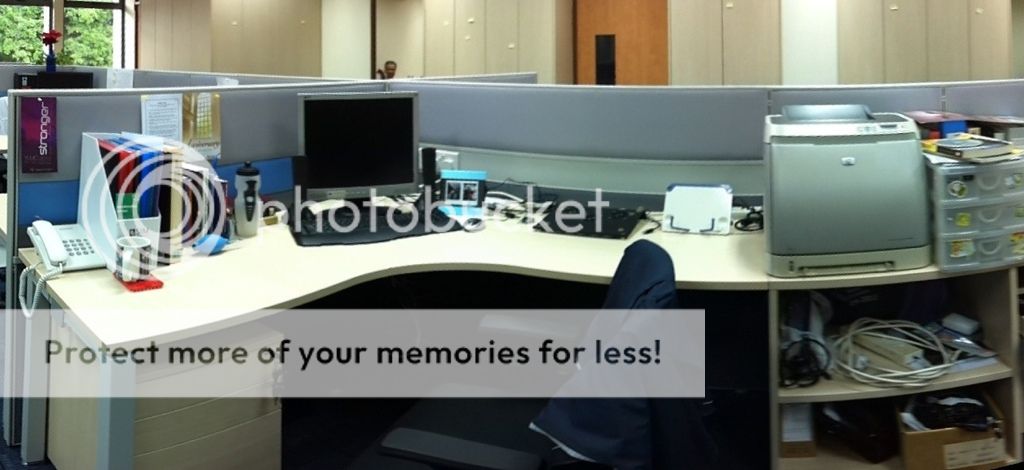
Maybe it's part of my training as an engineer, but when I saw things that were not being used lying around the house and in office, I just had to make use of those things and decided to put together a computer system for my new office space:


When we settled down in the new office, there were quite a few things lying about:
  • A spare 19" monitor
  • My personal spare keyboard (a Microsoft Sidewinder) and a set of Altec Lansing 2.1 speakers
  • A notebook cooler
  • A picture frame, which got filled up really quick :)
I hooked up the monitor, keyboard and speakers to my netbook, set the display out as "projector only" and let the computer decide on the optimum resolution for the display. Lo and behold, it looked and felt just like a desktop! The cool thing is that I can switch between using the netbook exclusively if I need more privacy (the 10" screen of my netbook is harder to take a peek at from behind, and I can use my mouse like a leftie), or if I need to run video calls from the webcam.

Zoom out a bit more, and you'll see my trusty iPad propped on a book stand.


You'll also notice that I have my iPhone connected to the netbook. I had to tether my 3G connection over the past two days, as our internet connection hasn't been set up yet in the new office. Although slower than WiFi, I still managed to upload photos to my Photobucket account, download videos and music for sermon prep, and use gChat with Christine.

Insert random pictures of cute kids here (Alex and Caroline brought Tiffany and Ian around the new office):


And a picture of the office eskimo, Irene:


And the last shot of the whole office (I saved the best for last!)


My Acoustic Rig

I'm an unconventional acoustic guitarist. Rather than going through the traditional route of drilling and installing an acoustic preamp on my "purely acoustic" acoustic, I decided to go with a Seymour Duncan Woody pickup:


Contrary to what your pre-conceived notions of acoustic pickups may tell you, it doesn't sound bad at all going through a PA and a keyboard amp (which I suspect is due to the fact that keyboard amps accept line-level and mic inputs to provide flat-response output). I've used this for acoustic gigs, corporate prayer meetings and church, and you know what? I've learnt that the audience can't tell the difference. Yes, I can't EQ the tone, adjust the volume or correct any phase issues, but the basic tone of an acoustic is there.


And the things I bring for the acoustic gig are:
  • A Korg Pitchblack tuner
  • A Visual Sound 1Spot power supply
  • A guitar lead


Yes, it's a rather strange setup for an acoustic rig, but here were my considerations in making this rig:
  1. I'm a sucker for passive pickups. Every acoustic preamp has the problem of 9V batteries waiting to die on you at the most incredible of times. With a dedicated power supply, my mind is free from that point of worry.
  2. With a tuner pedal, I'm able to mute the output with the click of a switch, instead of having to memorize the volume on the acoustic preamp, turn it down, and then having to turn it up when it's time to play again. And that's assuming the 9V battery hasn't died yet.
  3. You might be aghast at the length of cable that's floating about, but trust me, I'd rather have more cable length to walk around the stage than have too little and be confined to a corner, which is probably next to the drummer (and his cymbals).


Friday, October 19, 2012

Over-reliance

I have an iPhone 4 and I stuck on an anti-smudge screen protector as soon as I got it. I thought that it was absolutely necessary to have that additional layer of plastic. It gave a heightened sense of security. It gave more confidence to me as I handled (or manhandled) my phone with wet hands still drying from washing up, dirty hands from cleaning my car, and oily hands from checking my phone while eating my meals.

Two days ago, my sister gave me a new cover as a birthday present. It was a really cool cover that hugs the body of the phone very tightly--so tightly that when I put the case on, it managed to squeeze the screen protector right off! Naturally, I panicked. It was unprotected!

However, when I tried to use the phone without the protector, I noticed two things:
  1. The screen by itself is bright, clear and beautiful. There's detail in apps and photos I never knew was there until now. You actually don't need the screen protector, which reduces the brightness and clarity of the screen by quite a fair bit. I'm sure Apple designed the iPhone to operate without a screen protector, and it certainly can.
  2. You can exercise some extra care by ensuring your hands are clean(er) before handling the phone. Even if the screen gets smudged, it's a minor annoyance which can be addressed with a simple cleaning cloth.
Now, I'm a big fan of teachable moments, and I firmly believe that God uses anything and everything to teach us. As I was reflecting on the new-found brightness and clarity (it was there all along, just clouded by the screen protector), it gave perspective on how we Christians read our Bible. We're privileged to be in a modern age where information is accessible, and consequently we have many things to supplement our Bible reading. Examples include devotionals, commentaries, bible study articles, sermon videos on YouTube, and a multitude of iOs apps. The list will certainly get longer as technology progresses.

The supplementaries are great. The hard work of bible study is done for us, so all we have to do is simply read the interpretation. Difficult passages containing idiosyncratic phrases or eccentric behavior become easier to understand once we recognize the nuances of the language and the cultural context in which they are written. However, while I'm glad that we have unhindered access to such supplementary materials, I'm concerned that there may be an over-reliance on them to the point that we feel we cannot read, study, and apply our Bibles without them. If we were to be honest, we would admit that:
  1. The Bible by itself is entirely sufficient. Like the iPhone screen, it is clear, bright and beautiful for those who would read deeply into it. Psalm 119:105 reads that "Your word is a lamp to my feet and a light for my path". I'm sure God designed us to be able to interpret His word without supplementaries, and we certainly can.
  2. We can exercise some extra care in reading the Bible. When Jesus taught that we are to love the Lord "with all our mind", I believe that one aspect of that is to take the study of His word seriously. This means doing the hard work of bible study ourselves, taking on the role of the biblical interpreter. When and where was the text written? What type of literature is the text? What kind of literary devices are used by the characters in the text? What is the central idea of the text? Does reading before and after it give clarity as to what the author of the text is trying to say? Even if we don't understand the text fully, it's a minor annoyance which can be addressed by letting other parts of scripture shed light on the text in question.
Of course, if you're a new Christian, reading and interpreting your Bible for the first time is daunting and can be intimidating; by all means, refer to the supplementaries. My challenge is to the seasoned Christians out there--those who have the capacity, capability and the responsibility to read deeply into God's word.

    Tuesday, September 18, 2012

    How to Play By Ear

    The following is from a forum post by a beginner musician seeking help on figuring out chords by ear:

    Puffia:
    I need help on doing covers!! i cant really figure out the note in the songs i want to play
    Trying to do a cover for this (Everybody Talks by Neon Trees)->

     http://www.youtube.com/watch?v=1tMsH...el_video_title
    Can you guys give me some tips? D:
    thxs alot


    Me:
    Figuring out a song by ear makes use of two different skills that you can develop: absolute pitch (how to tell what the notes exactly are) and relative pitch (how to tell the relationship between chords/notes). For pop songs, such as the one you posted, it isn't very crucial to know exactly what's being played, because the chords used in the song are easy to decipher and fall into predictable patterns. To break it down briefly for you, using the song "Everybody Talks" as an example:

    1. Figure out the key of the song by finding the root chord. This is the chord that every other chord in the song will feel like changing to eventually. Very quickly breeze through all possible root position major chords to find one that "sits" with the song. Pop songs are easy because the root chord is normally very strong, in fact, for this song it's the first chord. And to make it easier, they hum the triad of the chord for you (0:00-0:04). This song is in Eb.

    2. Know what are the "normal" chords in that particular key (in music lingo, you're looking for chords diatonic to the key). For brevity, I'll just mention that there are 7 diatonic chords in every key, numerically notated in Roman numerals: the Root or I chord, minor ii, minor iii, IV, V, minor vi, half-diminished vii, back to I. Pop songs don't want to scare listeners with weird chord progressions, so they tend to be easy and stick to every possible permutation of I, IV, V, minor vi. In the case of the song, it's Eb, Ab, Bb, Cm.

    3. Find the intervals of the chord changes. Long story short, when Eb changes to Ab, there's a certain "sound" to that space between the two chords. That space will sound different between Eb to Bb, Ab to Bb, Cm to Bb, etc. At first, I can assure you the process is quite laborious; I fondly remember having scrapbooks of notes I took while figuring out chords to a song. Since a guitarist can only really play one chord at a time, it's a process of elimination to find out what the next chord is (assuming you've done Step 2). In time, you'll be able to hear I-IV, I-V movements, then extend that over longer chord changes, like I-IV-vi-V.

    4. Then figure out how long each chord lasts (ie does the chord last for one measure, does it play over two? Is there half/double time chord changes?) according to the time signature. Neon Trees isn't Dream Theater, so it's strictly 4/4 for the entire song.

    LONG STORY SHORT:
    • Intro: Repetition of the I chord. Play Eb
    • Verse: Repeating pattern of I-IV, each lasting two measures, so ||Eb---|Eb---|Ab---|Ab---||
    • Prechorus ("...everybody talks, everybody talks..."): The V chord is used to enter the chorus over four measures. |Bb---|x4
    • Chorus: This gets a little interesting. We normally hear progressions in groups of 4 bars. This time, it's a 6-bar group
    |Eb---|Eb---|Ab---|Ab---|Bb---|Ab---|

    The 2nd half reverts to a familiar 4-bar group. Then they throw in a weirder chord to spice things up, the major III, in this case G7:

    |Eb---|Eb---|G7---|G7---|Ab---|Bb---|Eb---|Eb---|

    Hope this helps to get you started. 

    Monday, September 17, 2012

    Going Fender


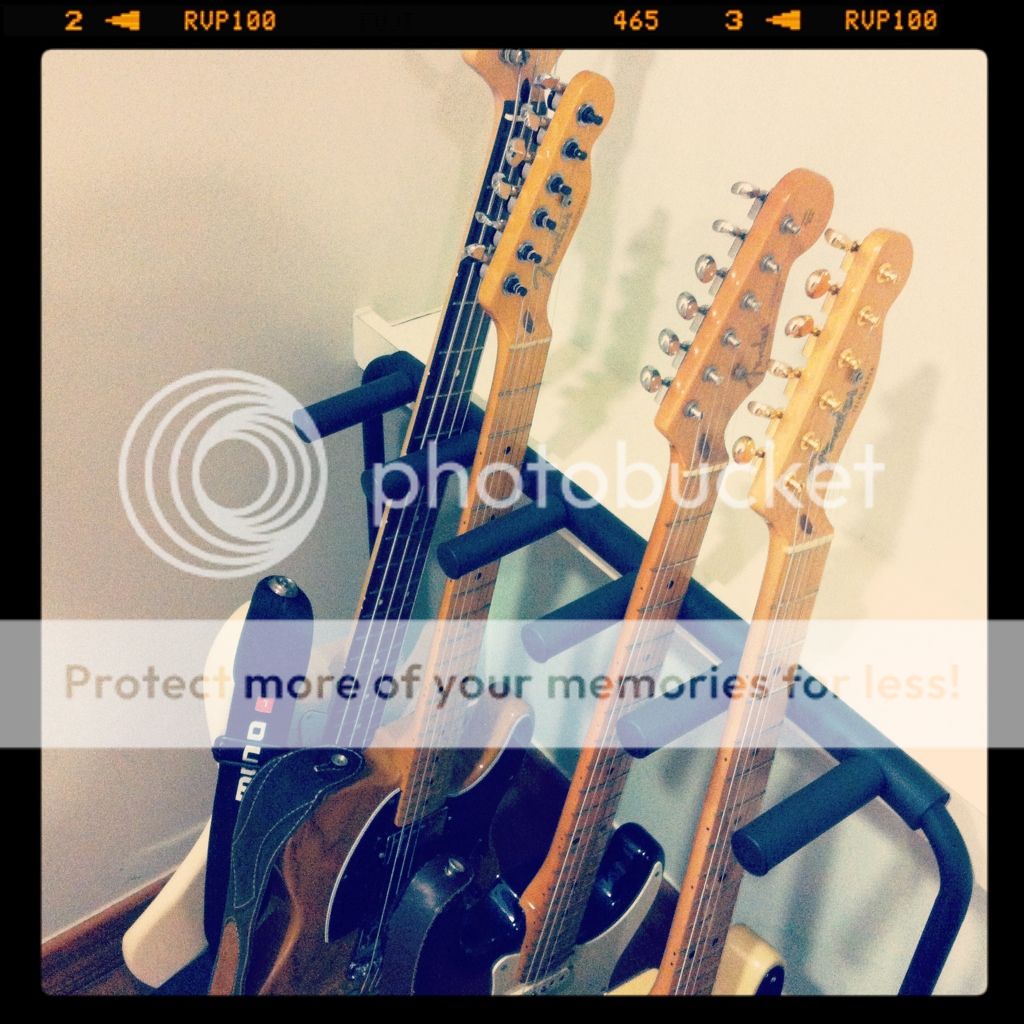
    Fender guitars used to bear the brunt of my guitar manufacturing criticisms. For a design which has essentially gone without much significant revision, I concede that Leo Fender got part of the formula right. I use the term "part" because the design isn't perfect. There are obvious flaws with the solid-body electric design: early '50s models can only make truss rod adjustments by removing the neck first, the V-shaped neck is awkward to grip initially, the tiny frets meant you have to be precise and fret lightly, and true single coil pickups have worse grounding than the cheapest radio you can buy.

    When faced with these problems, guitarists can choose to react in one of two ways. Firstly, they can avoid the problem altogether. It is certainly a more natural solution to find guitars which address and correct the flaws. Parker and Steinberger guitars, for example, have far superior playability, durability, balance, and features. Adrian Belew of King Crimson made the switch from Fender (most notably known for his iconic pink strat) to Parker because they "have none of the inherent problems and make [him] play better". 

    On the other hand, guitarists can accept the flaws and work around them. I have personally gone through this route and can attest: it's a lot of hard work. To play fast and fluidly on a strat requires one to be precise and accurate with a light touch in both hands. Your left hand has to accommodate the neck profile and small frets by bending in a certain way. Your picking hand has to play around the pickup spacing and slanted bridge pickup, being careful not to knock into the volume knob.

    To cut a long story short, I think by accepting and accommodating these flaws, I've ended up becoming a better guitar player. I was a very heavy player with a heavy hand who came from a metal background, so when the time came to retire from that particular scene, I needed guitars that were suited for far more mellow music. Acquiring my strat and tele has lightened up my touch tremendously, and that has made me far more dynamically-sensitive.

    Perhaps most pertinent to a GAS-prone guitarist is that you'll have to acquire more gear to get a single coil to really sing. They aren't as beefy as their humbucker counterparts, and they tend to have this shrill treble bite to them which isn't too appealing in a modern musical context. My personal solution was to stack my overdrive pedals with some EQ to roll off that high end, both on the guitar and on the amp side. I think this has had the side effect of making everyone's single coil tone unique, in that people use different configurations of pedals and amps to achieve an entire spectrum of tone, from full and fat to thin and shrill.


    My simple exhortation to those dismissive of Fender guitars is to try them out. Take a vintage guitar out for a spin. You just might be very pleasantly surprised.

    For further viewing:
    Dave Hunter and Carl Verheyen demonstrate telecasters

    Carl Verheyen demonstrates his stratocaster

    Sunday, September 16, 2012

    The Responsibility of Followers (1Cor4:6-14)

    What do you do when your young ones in the faith have severe disciplinary problems? Look to Christ.


    Wednesday, September 12, 2012

    Bitter Water Made Sweet (Exodus 15:22-27)

    As an inaugural post about bible study, allow me to divulge that bible study is one of the few things I am passionate about. I love it and I want to make freely available my devotional and bible study material for you. I hope this blesses you!

    Thursday, September 6, 2012

    Going Acoustic in a Church Setting


    Being an acoustic guitarist for church can be challenging. I had the privilege of playing for Pastor Anthony for the recent LCEC Planning Retreat, and it was the first time in a long while picking up the acoustic for official duty as a guitarist. Nothing too difficult: 8 songs, all mostly of the same contemporary genre.

    However, I realized that some of these songs had huge band arrangements: guitars, drums, bass, keyboards, synthesizers and horns, for the worst case of the lot. I had to somehow play the acoustic in such a way to fill up the whole musical pie chart (in Paul Baloche's words, when you're the only musician, you're the pie).


    Now, as an acoustic guitarist, you're never really replacing the other instruments in the band--you're "tricking" the audience into hearing something that reminds them of other instruments, but not actually emitting the sounds of the other instruments. Here's a breakdown of the mental process:

    1. The first step I take to making an acoustic arrangement of a big band song is to visualize what the drum kit is playing. The drum groove gives a big clue as to how to construct your strumming pattern. For example, an accented muted-down-stroke could mimic the intensity of a kick and an accented punch with a full chord could mimic the snare.
    2. I then try to visualize the bass line for the song. This will help create moving lines between chords, filling up the melodic space in the lower-end. For example, a chord chart may show a repetition of ||F - - - | G - - - | F - - - | G - - - ||, but once you think like a bass player and add a walk-up, i.e. ||F - - - | G - - - | F/A - - - | G/B - - - ||, you add a whole dimension of colour to the progression. A quick cheat method is to look out for the slash chords in a full-band chord sheet, or the piano chord sheet.
    3. I'll then try to hear and incorporate the melodic hooks of the song into the "safe" places: intros, end of choruses, first bridge. This breaks the song out of chord-only-monotony. "From the Inside Out" by Hillsong is a good example (see my video tutorial of the intro played fingerstyle below). It has a terrific hook and shouldn't be left out when playing this acoustically.
    4. If I have the time, I'll try to figure out if I can play any fill-ins at the turn-arounds of the song. In our modern musical context, this usually happens between verses, or from intro to verse, and sometimes even between a verse. Acoustically, this can be in the form of hammering-on/pulling-off chord tones, or a quick scale run (like Tommy Emmanuel).
    I hope this gives you useful ideas on how to incorporate "tougher" songs into smaller settings like cell group meetings.


    For viewing:
    My "From The Inside Out" acoustic riff video tutorial

    Twitter Delicious Facebook Digg Stumbleupon Favorites More