Dotted Eighth Delay Studies

Setting up the U2/Hillsong delay in a variety of situations.

The Sessionists

Esther Subra (vocals), Serena Chew (keys), Justin (guitars), Alphonsus (drums and percussion)

Thoughts on G.A.S.

Why you should save up for an expensive guitar.

Setting Up Disaster Area DPC-8EZ and DMC-8D MIDI Controllers

An easy-to-follow video tutorial to get those patches programmed!

An Overview of My YouTube Channel

Feel free to browse some of the playlists on my channel. Hopefully this leads to you liking and subscribing!

Showing posts with label Amps. Show all posts

Thursday, March 7, 2019

Tone Pursuit: Analog vs. Digital

I did a series of two videos to present the pros and cons of the Line 6 Helix versus an analog pedalboard. I love all gear, and believe that there can be a time and place for their use. I hope these bless you!


Thursday, August 18, 2016

A Major Update!


So I'm supposed to be studying but the lighting conditions are far less than ideal, so I'll take a little break to blog before moving up to my room where I have much better lights (but also much more distractions). Here's the update of my life for the past few months, so I'll be concise and share the relevant stuff.

Study, study, study!

The biggest update is that I've stopped work at AMKMC and am now a full time theological student at Trinity Theological College. I'll let some of these photos do the talking for me:

Orientation Day was packed.
My class is huge!
At the TTC chapel, where I go for chapel services, a staple part of student life.

The Hebrew Aleph-bet (alphabet), which we had to memorize on the first day.

Genesis 1:1 in Hebrew.

Church history class.

This year's CSCA lectures with Dr. Simon Chan on "Subversive Liturgy".

Random picture of Jumbo sleeping under my car while taking a break from studying.
Our visit to St. Mary of the Angels for our Field Education.

Reading my Mission and Evangelism textbook with a book stand to alleviate some of the "eyeball aches" I've been getting recently.

A view of the chapel from the back (where I'm usually now since undertaking AV responsibilities).

I've completed my first year Old Testament and Theology courses, so "by right" I should have more time to study than my fellow first year sufferers. But the truth is, I feel like I don't. I'm discovering that in order to retain information, I can't read at my usual pace. I miss out a ton of details! With Thursday mostly free and Friday all to myself, I pray that I will be able to catch up with my friends who are so well-adept at reading and writing. You can keep me in prayer for:

  • Church History - I'm really quite bad at geography and remembering places!
  • Hebrew 1 - 'Nuff said.
  • Mission and Evangelism - A mountain of readings, and a lot of group projects. Thankfully, my group mates are amazing!
  • New Testament 1 - The hardest for me so far. Our textbook isn't the friendliest and I've had to read up or watch other lectures to make sense of what the author of our textbook is trying to say.

Gigs and gear adventures

By the grace of God, I'm still able to get some vitamin M (music) in my system. My ministry "swan song" was serving on a worship team at this year's YMEFLC (Young Methodist-Evangelical Free Leaders' Conference), which I had the immense privilege of playing through a Fender Deluxe Reverb. Tonal bliss!

My amp sim became a mute switch. What a beauty of an amp!
In September, I'll be performing with some pals of mine I've come to admire and respect at Blujazz. Ivni and Wai Yee are blind musicians and are part of an annual concert at Blujazz (Ivni is a drum student at Bossworkz Music School, and yes, he is a blind drummer!) and I've had the privilege of meeting them to play on their bands for the past two years. It's a humbling experience to play alongside them because they show me that music transcends boundaries, even physical ailments.

I didn't have time to take a picture of them, but here's a shot of me rehearsing with an iRig Pro interface and using my phone as the effects processor.


Also, I think I've discovered that there is no way to achieve high gain tones through analog pedals unless you have a decent high-gain amp--which I will never own. Hence, my recent acquisition of iRig gear to play heavier stuff: and I'm mightily impressed! How I wish this technology was available to me when I was starting out! iRig equipment makes the multi-fx style of gear much more accessible for the beginner guitarist.


Soli deo gloria. Now, back to studying!

Saturday, January 18, 2014

Gear Review: Surprise Sound Lab Rock Block and SE-5 Speaker Emulator

When you hear the terms "1-watt head" attached to an amplifier, the immediate thoughts that come to mind are, "lack of headroom" and "too small-sounding". I was quite pleasantly surprised by two "pedals" offered by Surprise Sound Lab. Why the quotation marks? Well, I can't really classify them as pedals even though they can certainly fit very nicely on a pedalboard. The Rock Block is a true tube-driven, fully analog amp that's a direct competitor to the Zvex Nano Head and can run any cab of your choice, or as a stompbox integrated in your chain of effects. It has a really good clean tone that has surprisingly good headroom. Even when cranked, you can use the good 'ol combination of picking dynamics and pickup volume to clean up nicely.

Here's my video review with the SE-5 speaker emulator.


Understandably, the tone with a speaker simulator will not be the same with a cab played live. Running this into a Vox 2x12" cab really brings out more thumping low-end and definition (which I think will be even better with a 4x12").

As for speaker emulation, I quite like the tweakability offered by the SE-5. Other speaker sims only allow +/-20dB jumps in volume, but the SE-5 offers 8 notches of +4dB increments, allowing you a fair degree of fine-tuning when running this live into a sound console. The tone control is also very useable, and to my ears, going from 0 to 10 corresponds to a decrease in the virtual cab/speaker size. At 0, I think it sounds like the boomiest possible 4x12", and at 10, it reminds me of an 8" Fender Champ, with all the gnarl and snarl associated with those types of speakers.

In this video, I do a shoot-out between the SE-5 and a cheaper Mooer Micro-DI:


Thursday, December 5, 2013

The Feel of an Amplifier


I never had a noise issue with the neighbors. When I was starting out, I learnt to shred on a PODxt played through my computer speakers, so the volume was always under control. When I now have the room space and the funds to purchase an actual amp, I seem to have outgrown my shredder phase, and by association, the need for a tube amp.

That being said, I have experienced the joy of a tube amp at its sweet spot. And sometimes, those sweet spots are unavoidably loud. I fondly remember a day in Sydney when I heard an authentic early-era Marshall (with the block logo!) with KT-66 tubes in it. The shop owner grinned at me when I enquired about it and said, "Get ready to hear how heaven sounds like!" It was non-master volume, and when he strummed that E major chord, I almost nearly thought I saw a reinactment of the famous guitar-amp-sends-Michael-Fox-flying scene. Except there was no broken glass. Or people flying.

Amps are made to be loud. The one aspect of playing through an amplifier that digital modeling cannot capture is the feel of the amp, when the speaker and cabinet vibrate, transferring that mechanical energy to the surroundings.

I can think of three contributory factors to the feel of an amp:

1. Cabinet size. Closed-back, open-back, speaker configuration of 1, 2 or 4, cabinet material, whether the cabinet is enclosed with the electronics (like a combo), or separate, height and angle of elevation--these things affect how the cabinet vibrates. In my opinion, amp stands are less helpful than they appear to be. Although they help to point an amp to the guitarist, you will lose a lot of low end because the amp is no longer in contact with the ground. 

2. Power. Many of today's amps are headed towards the micro-amp head design, with smaller wattage ranges from 5W all the way down to 1/4W. Having watched these adverts, I think while the amp makers mean well and present a simple amp design, they over-simplify the role of power in an amp. A small tube amp with a small wattage will never sound big--the speakers aren't being driven hard enough (and probably not big enough either). In my experience, a guitar amp starts to truly sing when the power section runs at 30W. Remember, a tube amp running at 30W is a lot louder than a solid state amp running at 30W.

3. Speaker size. Again, as a result of the micro-amp design, the market is seeing a rise in popularity of 10" and 8" speaker cabs. Now, this is not to say that amps in small speakers are inferior, they're just different--anyone who's played a Supro amp or a Fender Champ will tell you that despite its tiny size, the amp can serve up an incendiary tone. The general rule of thumb is that the smaller the amp and the speakers, the faster the amp breaks up when the volume is turned up. And because the speakers are small, the breakup sounds different to a larger cab being driven hard. Both kinds of tones are palatable and definitely usable; it's just a matter of taste.

For further reading:

Tuesday, February 21, 2012

Analog, Digital...Does It Matter?

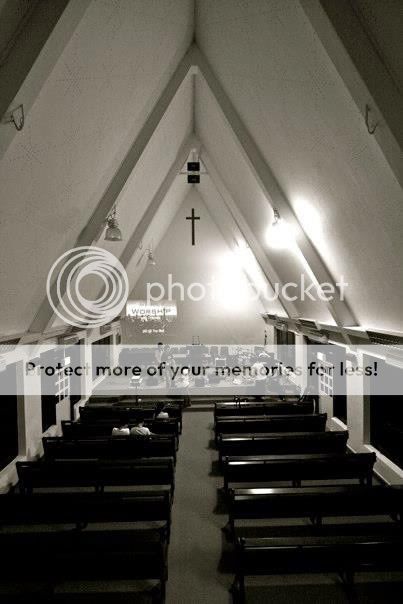
I've been playing worship sessions at a nice cosy church every last Friday of the month for a couple of months now. Hosted by Shalom Baptist Chapel, JAR @ the Well (acronym for Jam and Refresh) intends to deliberately bring worshippers from out of the hustle and bustle of city life and simply enjoy God through worship and music, and it achieves this aim very well because of its location: it's near Tengah Airbase!


The acoustics are amazing; there's a high, tapered ceiling, and the floor's nicely carpeted, which produce nice reflections with not too much pre-delay (carpets absorb sound). Whenever I step into this church, I feel inclined to be silent, to be meditative, and to be wary of my speech because of how small I feel.


My rig for the night was an experimental one: full pedalboard (the one I have mounted on a PT-3) into a Line 6 Spider III. It's a 30W amp with a 12" speaker, which is my preferred wattage and speaker size. I ran it pristine clean with no EQ and no drive to experiment with the concept of relying purely on the pedalboard for tone.


So the night went on, with powerful worship, amazing moments of pure adoration through the music, and all the while, just genuinely having a good time with the rest of the band.


The worship leader came up to me after and asked how much my amp was, expecting it to belong to the "expensive" category. "I love your amp" were her specific words. I guess she wasn't expecting that I paid $150 for it, and that it was a solid state amp.

So, which component was responsible for good tone? The amp? The pedalboard? The fact that I used analog pedals? The more I contemplate about it, the more I think that from a listener's perspective, it doesn't really matter if I used digital or analog. Both types of gear are thus a means to an end: undistractedness in playing. Perhaps the mark of good gear is not just that it sounds good, but it doesn't distract you while you're using it; it becomes an extension of your creativity, and you don't need to fight it to get good tone out of it.

What mattered lay in the generic rather than the specific: did I keep good time with the band? Did I play wrong chords? Did I use the right scale over the right progression?

If you insist on getting a particular piece of gear, by all means, save up, buy it, use it, and don't be distracted by it. Let the gear do its job by helping you express what you want to play.

Photo credits go to the amazing Chang Ning.

Due thanks to the amazing Yi Xin, whose heart for God and worship inspires the rest of us in the band to give and play our best.


Thursday, October 27, 2011

Analog in Disguise (Playing with Solid State Amps)

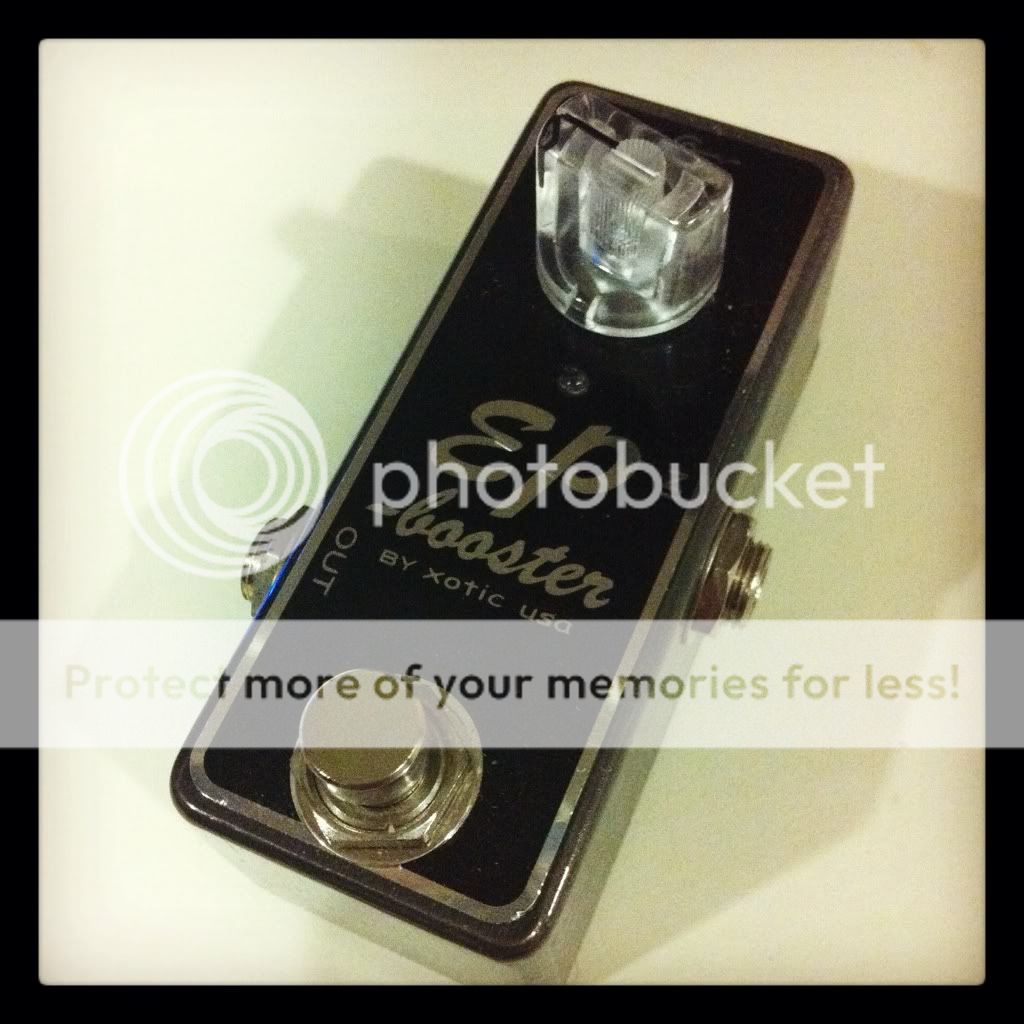
I got my hands on another EP Booster. Before labeling me as an excessive tone nut, let me justify why. Xotic came up with two versions of this pedal: Version 1 has a bright switch and a bass boost, while Version 2 replaces the bright switch with a +3dB boost (which in essence is a unity gain switch, because when disengaged, there's no boost). You can run this pedal on anywhere between 9V to 18V, where 9V gets you more gain and compression, and 18V gets you more clarity and headroom. I personally like the sound of 18V, so both my EP boosters are cranked with that voltage.

Now, I normally don't gig with my own amp because it's a 55lb monster, and my pedalboard is set up such that 90% of the tone comes from the pedals, and I run the amp clean with no drive at all. This theoretically means that I can play through solid-states and tube amps alike with little difference in tone.

Here's the problem: solid-states don't have a nice power amp, and tend to sound flat, lifeless, harsh (insert negative terms here) without the warm, fat response I like with a tube-driven power amp (to clarify, I find that even solid-state rectified tube power amps sound great to my ears). So while my first EP Booster is acting like a preamp, I'm using the second EP Booster as a "power amp".

Enough anthromorphic babble. Let's jump right into the set up. The rule of thumb with pedals:
  • Pedals sound different when placed in various places. For the EP Booster, placing it before overdrive pedals tends to squeeze more gain and compression out of the overdrive.
  • Pedals at the last of the chain tend to influence the tone most. When the EP Booster is the last in the chain of overdrive pedals, it provides more clarity and dynamic sensitivity, allowing you to roll back the guitar volume to clean up. With my fingerpicking technique, I can also get a rounder tone using my fingers instead of a pick.
You'd notice that the EP Booster only has one knob, and I'm making it sound like there are many switches to toggle. Well, there are switches; you just can't see them. They're dip switches inside the pedal, so you have to use a screwdriver to dig into the pedal. Let's take a look at the manual for where the dip switches are located:
I managed to flick the switches down with the long bit of my fingernail. Either that, or a simple flathead screwdriver will do the job. Don't worry, these are really tough switches which don't break easily. Let's see how I set this up on my pedalboard:

The Setup
  1. EP Booster Version 1 - Run at 18V and at "Vintage" settings (both dip switches down)
  2. Overdrive pedals
  3. EP Booster Version 2 - Run at 18V at "Unity Gain" settings (don't engage the +3dB switch)
  4. Volume pedal
Older setup, mid 2011

The volume pedal is essential to getting the tone right with solid state amps. I think it's got something to do with the fact that when you're hitting the front of a solid state with several pedals, a full signal will cause the front-end of the amp to clip. In a tube amp, this sounds great, but with a solid state, it's fizzy, harsh, lifeless (insert more negative terms here). I park the volume pedal at roughly 80% the way up.

Now, after all this time (and money) setting it up, how does this setup fare in real life?

I took this pedalboard to a gig where I used a Line 6 Spider III 30W. Someone came up after the show and asked what amp I was using, expecting it to belong to the "expensive" category of amps. I believe the word "flabbergasted" adequately described the reaction. :P

I haven't tried this out on a Roland Jazz Chorus though, so don't take my word that it works for all solid state amps!

For further reading:
Xotic's Product Page (for the white EP Booster)

Friday, September 23, 2011

Massive Unboxing!

A clearance sale is bound to strike a good chord in a guitarist. I've always dreamt of owning a THD amplifier for years, having seen small blurbs of it in guitar reviews, and hearing raves amongst my guitarist friends. Reading about the features was enough to convince me that this amp was worth the boutique price tag that it carries.

I finally found a place that sold THD products, and specifically, the combo version of the UniValve! Kudos to Chao for the great tip-off! I made my way from an external course at work, traveling from Science Park to Peninsula Plaza at peak hour, with ERP and parking, just for it. Yes, it's worth that amount of trouble.

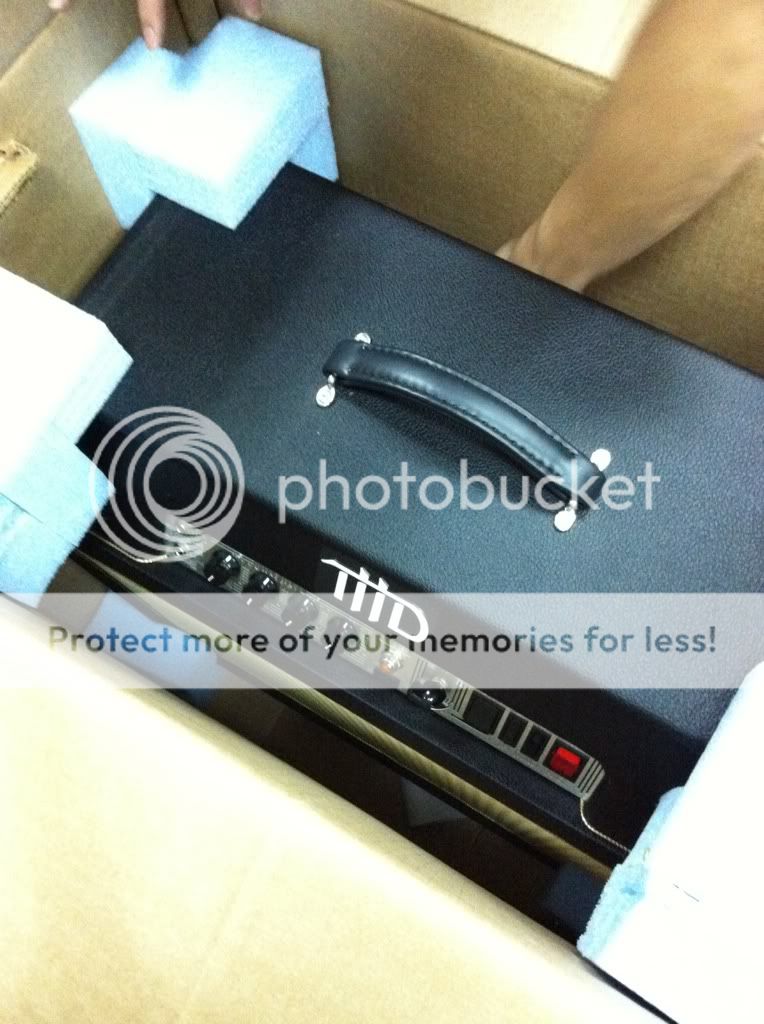
The picture doesn't really show its size. It's a whopping 53lbs and I had to leave the box at the shop!

Unboxing...

The styrofoam in the box provides more of a psychological assurance than actual protection. This baby is built like a tank.

Installing the wheels. Who would have thought it would finally be available on an amp?

And finally, when I lugged it back home and set it up...
This amp delivers serious tone. Everything I threw at it, even my cheapest pedal and guitar, sounded gold. Here's a run-down on what I love about this amp:

The tubes and the Hot Plate
The UniValve is single-ended Class A amp (don't worry, I've provided links to other sites for those of us who don't know the geek lingo), which is my personal preference when it comes to amplification. I think I won't burn the tubes out as quickly as my other friends do, considering my drive section is completely dependent on my pedals and I run the amp pristine clean.


It has two 12AX7's in the preamp and one EL34 in the power amp. Like most tube amps, there are two channels for low or high gain input--which, I recently discovered, simply meant how many tubes were used in the preamp. In the UniValve's case, it's a choice between one or two tubes, and there's a serious jump in the amount of crankable gain between the two channels. The first preamp tube governs the gain and tone of the preamp, while the second preamp tube directly drives the power tube. By varying the gain of these two tubes, you can influence the mix of preamp distortion and power amp distortion, or run a decently clean tone at higher volume by reducing the gain of both.

The power amp tube makes a profound difference on your overall tone, and the EL34 is a favorite of mine.  It has a middy character to it, and has a ton of headroom and volume. A friend of mine joked that if you want to hear an EL34 break up, stand really far away.

My favorite setting so far is the volume at half and the Hot Plate at half. If you run your rig like mine, where your pedals are your main source of overdrive, playing your amp at a volume lower than its breaking point will sound over-compressed. However, if you run an attenuator, the more you attenuate the signal, the amp becomes less open and you lose some dynamic depth. It's a delicate balance that I've easily achieved with the UniValve.

The controls
With clean amps, I'm a follower of the fabled Fender Deluxe Reverb mojo settings: 6-6-3 (Bass, Middle, Treble respectively), which provide a woody body and a "blanket" warmth to the guitar tone. Instead of a middle control, the UniValve features an "Attitude" control, which I'll let the company describe: "The Attitude control determines how the driver stage responds to signal and how it drives the power tube." 

The general idea is that when turned fully counter-clockwise, it's more a Fender-like response, and fully clockwise is more like Marshall. THD says it's not a presence control, but the effect is in the same ballpark, in my opinion. Personally, I like it one-quarter up, to get that Fender character with a bit of Marshall bite.


At the rear, there are speaker output jacks for anything ranging from 2-ohms up to 16-ohms. There is also a fantastic isolated line out jack and control knob. You can actually use the UniValve as a preamp for other amps, or you can run it like stompbox in your signal chain. It also works great for direct recording., although you have to get a cabinet simulator, either from something like the Rock Bug by Carl Martin or the Palmer direct box. Alternatively, for the cheapskates like me, I record direct to my computer and use a free plugin. There is also a switch to toggle between instrument-level and line-level output. Its probably the best line-out feature set you'll see on a tube amp.


A few quirky noteworthy things about this amp to up the collector's value: it's signed by Andy Marshall himself, and every amp has a quote from philosophers, presidents, famous musicians, etc. My amp has George Harrison's quote, "All things must pass".  

The cabinet
It's a specially tuned-port bass-reflex cabinet that in their words, "significantly reduce standing-waves inside the cabinet, giving it a very deep, even, tight and punchy sound." To my ears, this sounds amazingly like a 2x12" cab. However, what really kicked up the cool factor for me is that the cabs are modular, meaning you can swap out the UniValve head from the cab for any of the THD amp heads. If I was crazy enough to get a BiValve or a Flexi head, it's possible to remove the metal grill, stick it into the cab, plug in the speaker cable, and it will fit!

In conclusion
I'm able to pull off tones ranging from Earth Wind and Fire to Dream Theater through this amp. I couldn't ask for more.

Further reading:

Twitter Delicious Facebook Digg Stumbleupon Favorites More