The short answer: most definitely. There's only one time a direct signal from the guitar into the board is acceptable, and that's to record a pure clean signal from the guitar. Jeff Baxter very famously recorded pure clean tracks for sessions when a clean guitar was required. Just check out what he says about equipment in the following video:
Here's a simple riff I recorded back-to-back, the first without speaker emulation, and the second with a 4x12" cab emulation from my Korg Pandora:
The distortion has peaks and spikes that are just ear-piercingly intolerable, doesn't it? Hence, a speaker emulation achieves its effect by mostly rolling off treble content.
If you're wondering what kind of content I produce on my channel, they're mostly lessons and play-throughs of songs. Feel free to browse my channel after looking through these playlists, and don't forget to like and subscribe!
(This is an old post which was left in my "Drafts" folder, and I must have forgotten to publish it. So rather than keeping it hidden, here it is!)
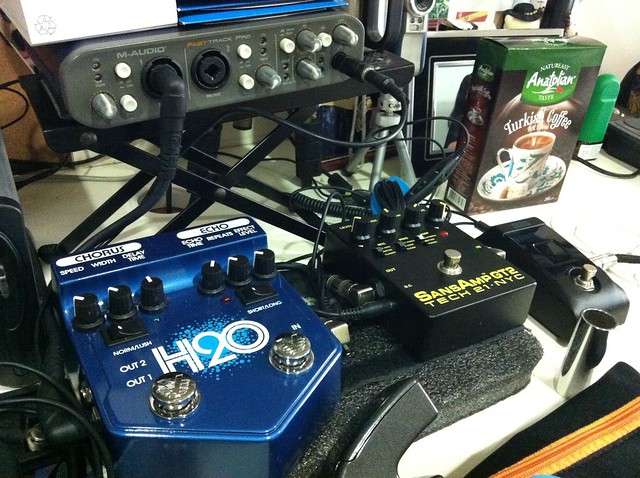
Less doesn't necessarily mean losing out. A smaller car is still a means of transportation, and it can have features which bigger cars lack (a retractable roof on a cabriolet over an ordinary sedan, for example). Likewise, when I was attempting to record using the SansAmp GT2, I found that its simplicity was its greatest strength. Here's my entire recording rig:
A tuner to keep the guitars in tune
The SansAmp GT2, an amp simulator with an arsenal of tone at my fingertips.
The Visual Sound H20, which provides depth to the tone with delay and chorus. I find that even when used in the "short" delay mode for a really fast slapback, the H20 has this effect of making your notes stick out more.
My trusty M-Audio Fast Track Pro. To keep the preamp noise of the FTP low, I set the gain to about 50% up, and adjust the Input gain of the GT2 to taste. I like to record to -6dB, which seems to be the threshold at which the guitar tone "speaks" with clarity, but that's my personal preference.
Character switches include
MIC:
Classic = distant miking without ambiance.
Center = close miking at the center of a speaker cone.
Off-Axis = close miking at the edge of a speaker cone.
MOD:
Clean, which gives you a stock tube amp set-up.
Hi Gain, which gives you an extra gain stage, as if you were to install an additional 12AX7 tube in the pre-amp section.
Hot-Wired, which gives you a scooped-out midrange for a sizzling, over-the-edge quality.
AMP:
Tweed = Fender®-style
British = Marshall®-style
California = Mesa Boogie®-style
Check out the Marshall tone from this setup!
It's great for bass tones too. I set this tone up using the manual's setting for "SVT Bass" style:
This post begins with a story. I've owned the Strymon "Trinity" (the nickname given to the collection of Mobius, TimeLine and BigSky pedals). While I had some limited control with the DMC-3XL, I was clearly in need of a solution to the problem I had with having so many pedals to switch, in addition to the patches I wanted to control on the Strymon devices. I had my heart set on getting the DPC-8EZ and DMC-8D, their two largest controllers that were designed to perfectly complement one another.
So enter the good people at The G.A.S. Station, a local company I chanced upon while searching on ways to bring in Disaster Area gear. I got in touch with Bertram, the proprietor, and we began the creative process of figuring out my rig needs. I placed an order for three things: the two controllers, and 3 packs of Disaster Plugs, the patch cables needed to wire the DPC-8EZ up. The excitement in me was palpable; I haven't had GAS in a very long time! This was in late November.
Bertram was very kind to keep me up to date with messages regarding payment and shipping. He sent me the shipment tracking number and this transpired:
I had hoped the shipment would arrive in December so I would have had time to put together the rig for Christmas services. But look at the date of the picture above. I took the screen shot in late January. The shipment was in transit from Germany for two whole months. There was no use getting angry over the situation; international shipments go awry all the time, and I was simply the one guy in a thousand cases to lose something.
My heart did sink at the prospect of having wasted a chunk of my paycheck--Disaster Area gear doesn't come cheap! So I talked to Bertram, and every effort was made on his part to contact Disaster Area, USPS, SingPost and even Singapore Customs. By early February, we had established that the shipment was indeed lost, but Disaster Area was very kind to build a replacement set for me. Yes, a replacement! Bertram, of course, never disappointed in his timely messages and open communication.
This time, the shipment came really quick. I got my hands on the pedals that I had been waiting three months for:
I would have thought that I'd need a lot of time to get the complete system up and running, but to my pleasant surprise, Disaster Area gear is so intuitive and easy to set up that I was programming patches in no time!
Of course, not all setups with new gear is without problems and learning curves. Here are some things I wish I could have done better:
I don't have proper wire cutters, so I used a large pair of scissors to cut the Disaster Plug cable. I think this may have contributed to the reason I wasn't getting signal in some of the patch cables I made, and I had to recut some patch cables several times to get proper signal.
I don't have a proper cable tester. My cable testing method was plugging the patch cable from guitar to amp. If the signal was strong and noise-free, I had a good cable. If there was no signal, I had to either tighten the ground plug or recut the cable. I would have saved a lot of time if I had a cable tester.
I don't have right-angled, low profile MIDI cables, so there was some pedal real estate wastage, as you'll see in my final setup below. Anyone know where to get right-angled MIDI cables locally?
Here's a quick video I did to show how to configure and program patches on the controllers, for those of us intending to expand our pedalboard with Disaster Area gear:
Once again, a great shout-out to Bertram from The G.A.S. Station! Give them a follow on Facebook and get some cure for that G.A.S.!
I had a moment with the Holy Spirit, which prompted me to segue into a song I hadn't planned in my setlist. I could feel everyone hop onboard that moment, and there we were, singing our hearts out, some praying in tongues, others, like me, singing from the depths of my tiredness, sorrow and pain a new song of praise and worship.
And when the moment passed and it was time for me to hand over the time, I got that look from one of the authoritarian Megalomaniacs in our midst: "What the heck are you doing?" (I've heard him use harsher terms on me before.)
Let me share from my heart (a rarity for me, but something I am embracing if I am to be authentic).
If authentic worship means being open to how the Spirit moves, and being ready to pour my heart out like an offering unto God, I don't see why I am being judged for obeying the Spirit. I hear Jesus calling me out to be raw and real. I hear the Spirit singing alongside my offering of worship. I sense the Father's smile as He looks on His worshipful children.
Sure, it wasn't planned. That's precisely why it's authentic. You won't hear my heart's cry when I'm rehearsed. But you see, that's the way God has wired me. I am made to worship in a certain style, in a certain setting. There is as much validity in spontaneous, raw worship as in traditional, quiet liturgy--all are expressions of worship God longs for us to engage in to meet with Him!
I challenge every worship leader to be conscious of how God has made you to lead. Are you in the traditional stream? Then craft corporate prayers to the glory of He who hears our every cry. Are you in the contemporary stream? Then let your worship flow with the fullness of the Spirit, letting your songs and dance and thoughts bring everyone towards the jubilant expression that God takes delight in.
How small can a pedalboard get? This was the challenge placed on my heart for a while, and I didn't have the chance to get down to actualize a fully functional pedalboard with my favorite tones at a fraction of the size. When I distilled my creative requirements for tone, I realized I essentially needed:
A wah pedal
A compressor
A boost
An overdrive
A volume pedal
A delay
Were there six such pedals in a miniaturized form factor? Yes! Hence, it was a matter of time (in acquiring the necessary funds) before I could put all of the essential components together to form the tiniest pedalboard I have ever assembled:
From right to left, the signal chain is as follows:
AMT Japanese Girl WH-1
Xotic SP Compressor
Xotic EP Booster
Xotic SL Drive
AMT Little Loud Mouth LLM-2
TC Electronic Flashback Mini Delay
And here's a short video on how I set up the overdrive section with the Xotic Trinity:
I wrote a short how-to for ministry members to view iCloud calendar events on their Google calendar spaces because some people just don't have iCloud access (being Android phone users). This is a short post, but I hope it helps you out as much as it helped me!
The last house gig and memoirs of playing at Blu Jazz showed me that giant pedalboards are not the way when all you need is a basic overdrive and delay sound. I thus began my search for a combination of micro-sized pedals that would require minimal setup/tear-down and maximum tone.
I initially toyed with the idea of using my improvised plastic case pedalboard, put together by repurposing a piece of foam (that came with a laptop case), cutting it down to size and slapping on some fuzzy-side Velcro. I quickly realized there were too many of the small pedals for practical use--so I have set it aside as a backup nano-board for the acoustic or the bass.
I then realized I really wanted full-sized wah and volume pedals, and I use them pretty frequently in my playing. Hence, I decided to mix-and-match my current pedals, partially upsetting the initial creative vision I had for a fully-nano sized board. Two more revisions led to this board:
This is a Pedaltrain Junior board outfitted with the following signal chain:
Xotic SP Comp
Budda Bud-wah
Xotic EP Booster
Xotic SL Drive
Cmatmods Signa Drive
Ernie Ball VP Jr
TC Electronic Flashback Mini
TC Electronic Polytune Mini (to mute the signal when I change TonePrints with my phone)
Earthquaker Devices Dispatch Master
TC Electronic Ditto Looper
Palmer PDI-09
All pedals are powered by a Diago Powerstation, and I repurposed a Fisherman's Friend tin as a pick/ear buds tin. I'll definitely be bringing this on a field test at the next service, and I'm excited to hear what happens!
By default, Windows 7 will search for drivers on Windows Update first before searching any pre-configured drivers on your system. This becomes painfully slow at times, and it's especially frustrating if all you're doing is changing which USB port you'd like to plug your mouse in. Fortunately, there is a way to change the order in which Windows 7 attempts to find drivers:
1. Search for "advanced system settings" and select "hardware".
2. In the "hardware" sub-menu, select "device installation settings".
3. Select "no, let me choose what to do" and select "install driver software from Windows Update if it is not found on my computer".
This will ensure that Windows will search Windows Update last, and trust me, it's a lot faster to get things done!
Meet the Strymon El Capistan. I haven't come across a better sounding tape echo machine in a very long time. Its controls are simple and intuitive, it has an impressive sound-on-sound looper, and in my opinion, is completely worth the hefty price tag it commands.
I've had the good fortune of hearing a vintage Echoplex EP-1 (informed readers would know that the EP-1 wasn't actually designated until the later models came out), a really old, beat-up unit from the '60s, and it was tube-driven delay heaven. I remember just being in the room, immersed in this sonically-pleasant wash that had a warm decay, and wishing I could have had grandparents who played guitar too.
Fast-forward a great many years and a friend loaned me an El Capistan. Playing around with it transported me back to that room with the Echoplex!